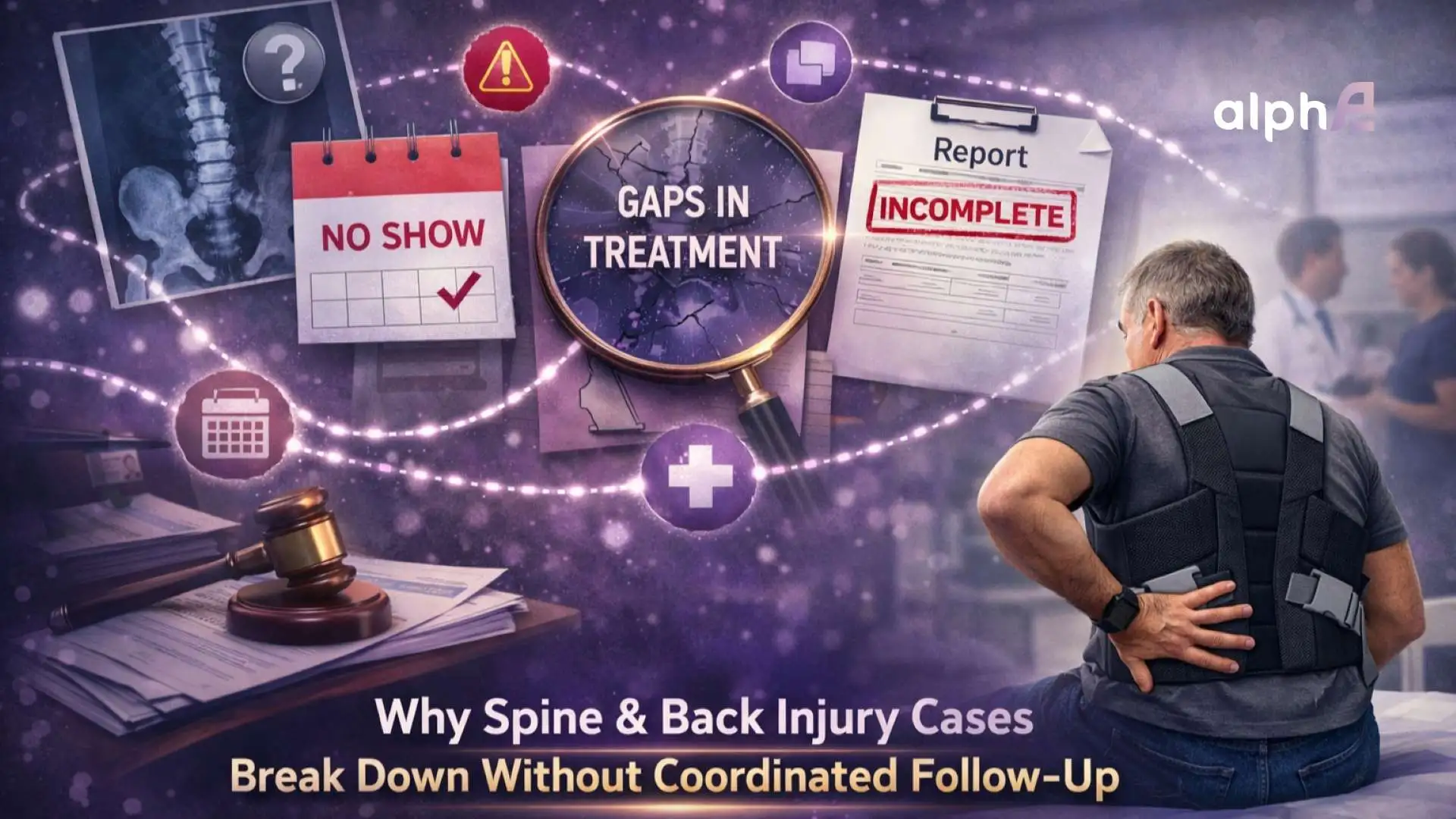
TBI case management in personal injury is often more difficult than other injury claims because the injury does not always present clearly at the start. Unlike more straightforward cases, traumatic brain injuries may develop gradually, with symptoms that are harder to recognize, document, and connect to the original incident.
In many cases, symptoms such as headaches, memory issues, or difficulty concentrating do not appear immediately after the accident. That delayed onset can complicate both medical evaluation and legal documentation, especially when the injury is not fully recognized during the early stages of the claim.
TBI cases also tend to involve multiple providers, evolving symptoms, and a treatment timeline that is harder to keep consistent from start to finish. As a result, these claims often require closer coordination than more typical injury cases.
In this article, we explain why TBI cases are harder to coordinate than other injury claims and what makes them more difficult to manage effectively.
Why TBI Cases Do Not Follow a Standard Injury Model
Most personal injury cases follow a relatively linear progression. A client is injured, seeks medical attention, receives a diagnosis, and begins treatment. Documentation reflects this process clearly, helping establish a straightforward timeline that supports the claim.
TBI cases rarely follow that pattern.
Instead, they often develop gradually. A client may feel relatively stable immediately after an accident and choose not to seek medical care. In the days that follow, symptoms such as headaches, confusion, or memory issues may begin to appear. This delayed onset creates a gap between the accident and the first documented symptom.
That gap is one of the most critical vulnerabilities in the case. Insurance companies often use delays in treatment to question whether the injury is actually related to the accident. Without early documentation, establishing causation becomes significantly more difficult.
For that reason, these cases require a different approach from the very beginning. Identifying symptoms early and ensuring timely medical evaluation can greatly improve both documentation quality and overall case strength.
Why TBI Case Management in Personal Injury Requires Specialized Coordination
TBI case management in personal injury requires a different level of coordination compared to standard injury claims.
Unlike injuries with clear physical symptoms, brain injuries often affect cognitive and emotional functions. This makes treatment more complex and requires input from multiple specialists.
In many cases, care must be coordinated across neurologists, therapists, and mental health providers. Each plays a role in documenting the injury and supporting the legal claim.
Without structured coordination, important details may be missed, leading to gaps in documentation and weaker case outcomes.
The Diagnostic Complexity of Brain Injuries
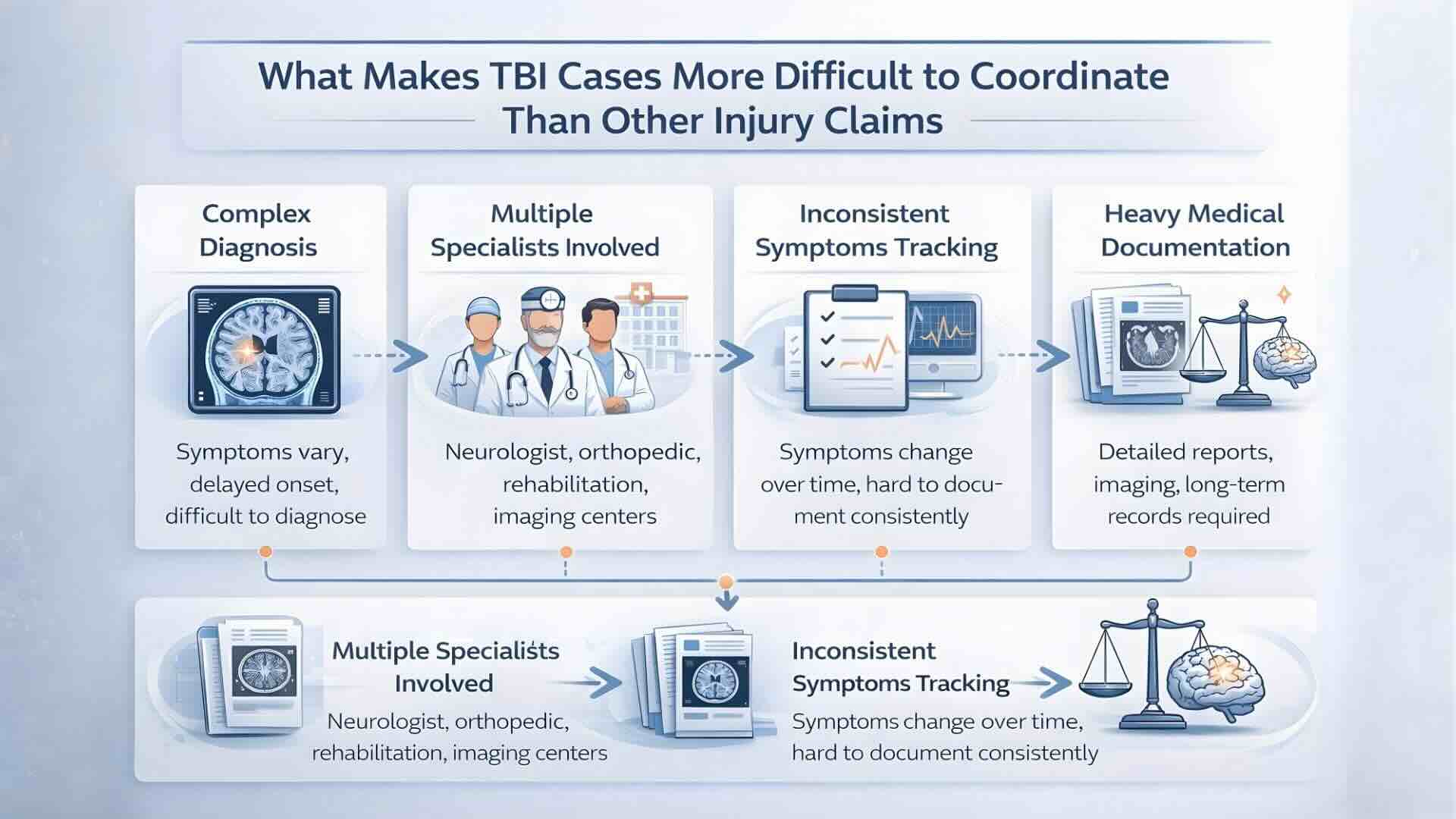
According to the Centers for Disease Control and Prevention (CDC), traumatic brain injury symptoms may appear days or even weeks after the initial injury. This delay makes early diagnosis far more challenging. Unlike fractures or structural injuries, TBIs are not always visible on standard imaging such as X-rays or even some MRI scans.
The Importance of Expert Evaluation in TBI Cases
Traumatic brain injuries often require evaluation by experienced specialists such as neurologists and neuropsychologists, especially when symptoms are subtle, delayed, or difficult to measure through standard examinations alone. Their role is not only to assess the injury clinically, but also to help clarify how cognitive, neurological, and functional symptoms are affecting the patient over time.
In personal injury claims, that level of expert evaluation can be critical. It helps document symptoms more clearly, supports causation when the injury is not immediately obvious, and gives the case a more credible medical foundation. Without it, TBI claims are often harder to explain, support, and defend.
Why Early Symptoms Are Often Overlooked
Many individuals do not immediately recognize that they have sustained a brain injury. Early symptoms can be subtle and may resemble stress, fatigue, or emotional responses to the accident.
Common early indicators include:
- Difficulty concentrating or short-term memory issues
- Headaches, dizziness, or sensitivity to light
- Mood changes, irritability, or unusual fatigue
Because these symptoms are subjective, they are often underreported during the initial medical visit. As a result, early medical records may not fully reflect the presence or severity of the injury.
This creates gaps in the medical record, which can later make it difficult to clearly link symptoms back to the accident. From a legal standpoint, that weakens the causal connection needed to support the claim.

The Role of Legal Intake in TBI Case Management
The intake process plays a critical role in identifying potential brain injuries. Unlike other injury types, TBI cases require attorneys to go beyond basic physical complaints and explore cognitive and neurological symptoms.
Clients often do not realize that issues such as confusion, forgetfulness, or difficulty concentrating may be related to the accident. Without targeted intake questions, these symptoms may never be documented early in the case.
Effective TBI case management in personal injury begins at this stage. Attorneys must identify potential warning signs and ensure that clients are referred to appropriate specialists as early as possible.
Early coordination helps establish a consistent medical record and strengthens the overall claim. When symptoms are documented soon after the accident, it becomes easier to demonstrate causation and reduce disputes later in the case.
This is where a structured TBI evaluation process becomes essential especially in complex injury cases that depend on early, accurate documentation, such as those seen in car accident injury cases.
Why Multi-Provider Coordination Makes TBI Cases More Difficult
Another major factor that increases the complexity of TBI cases is the involvement of multiple medical providers. Brain injuries often affect cognitive, emotional, and physical functions, requiring evaluation from several specialists.
A single TBI case may involve neurologists, neuropsychologists, rehabilitation therapists, and sometimes pain management providers. Each specialist focuses on a different aspect of the injury, which can create coordination challenges if communication is not properly managed.
Working across multiple providers often leads to recurring issues:
- Inconsistent documentation between providers
- Limited communication across specialties
- Fragmented timelines of treatment and evaluation
If these elements are not aligned, the case can quickly become disorganized. Even small inconsistencies in how symptoms are described can weaken the credibility of the claim.
Maintaining alignment between providers is essential for effective traumatic brain injury case coordination. A structured approach ensures that all documentation supports a clear and consistent narrative something that becomes critical during insurance review or litigation.
A Real-World Example of TBI Case Development
A common scenario illustrates how these coordination challenges play out in real cases.
A client is involved in a car accident and initially reports only mild discomfort. Believing the symptoms will resolve, they choose not to seek immediate medical care. Over the following days, however, they begin experiencing persistent headaches, difficulty concentrating, and memory issues.
At that point, the connection between the accident and the symptoms becomes less direct than it would have been immediately after the incident. Without early documentation, proving causation becomes more difficult and may require additional expert evaluation.
This pattern appears frequently in TBI cases, particularly when early symptoms are delayed, dismissed, or overlooked. It highlights the importance of early medical evaluation even when symptoms initially seem minor.
From a legal perspective, early documentation is often the difference between a strong case and a disputed claim.
Letters of Protection and Access to Medical Treatment
Access to care is a major issue in TBI cases, particularly when evaluation requires specialized testing, ongoing therapy, and extended monitoring over time.
Many personal injury patients rely on Letters of Protection (LOPs) to begin or continue that care without upfront payment. In TBI claims, this can be especially important because symptoms may develop gradually and require continued documentation across multiple stages of treatment.
When treatment is delayed because access is limited, the case can become harder to document consistently. In that sense, LOP-supported care does more than improve access. It can also help preserve the continuity needed to evaluate, document, and support a complex brain injury claim.
What Happens After the Medical Referral
After a TBI referral is made, the case often becomes more complex rather than more straightforward. The first specialist evaluation helps establish an initial medical foundation, but it is usually only the beginning of a longer diagnostic and treatment process.
Steps During the First Specialist Evaluation
During this stage, the physician may review how the incident occurred, document cognitive, emotional, and physical symptoms, and perform neurological or functional assessments. Additional testing such as imaging or neurocognitive evaluation may also be recommended, depending on how the symptoms present.
What makes TBI cases more difficult is that this first evaluation rarely resolves the full picture. Symptoms may continue to evolve, additional specialists may need to be involved, and treatment recommendations may change over time. That is why coordination after the initial referral is so important. Without clear follow-up and organized documentation, the case can quickly become harder to manage and harder to support.
How Early Treatment Strengthens TBI Claims
Early treatment is especially important in TBI claims because symptoms are not always obvious immediately after the incident. When medical evaluation begins early, the record is more likely to capture cognitive, neurological, and functional issues before the timeline becomes harder to document clearly.
That early documentation helps connect the injury to the accident, supports causation, and creates a more reliable foundation for the claim. It also makes it easier to track how symptoms evolve over time, which is particularly important in brain injury cases where the full extent of impairment may not be clear at the start.
When treatment is delayed, those early signs may go undocumented. As a result, the claim can become harder to explain, harder to support, and more vulnerable to scrutiny. alphaE explores this issue further in this analysis.
Conclusion
Traumatic brain injury cases are harder to coordinate than many other personal injury claims because symptoms may appear late, diagnosis is often less straightforward, and treatment frequently involves multiple providers over time.
Effective TBI case management depends on early identification, structured follow-up, and consistent documentation across the course of care. When those elements are in place, the case is easier to evaluate, explain, and support.
When they are not, even small coordination gaps can create larger problems in the medical record and weaken the overall claim.