

For personal injury attorneys, the provider a client sees first can influence the direction and credibility of the entire case. The wrong provider can create documentation problems that may only become visible months later when the case moves toward settlement. That’s why understanding how to vet LOP medical providers before sending a client for treatment is so important.
Many physicians are willing to accept a Letter of Protection, but willingness alone doesn’t guarantee the referral will help the case. Some clinics struggle with consistent medical documentation, while others delay appointments or lack experience handling injury-related treatment.
Insurance adjusters closely examine medical records, treatment gaps, and diagnostic timelines when evaluating injury claims. A poorly chosen provider can quietly weaken the medical evidence behind the case.
For that reason, PI attorneys need a more deliberate referral strategy. This article explains how PI attorneys can evaluate LOP-friendly providers, reduce unmanaged referral risks, and build stronger medical provider networks that support both treatment and litigation strategy.
Why Provider Vetting Matters in Personal Injury Cases
In many personal injury cases, the first treating provider shapes how the claim is later evaluated by insurers. When the initial provider documents the injury clearly and establishes a consistent treatment timeline, it becomes easier to connect the accident to the client’s condition. Attorneys who want to better understand how early treatment decisions influence documentation can review Alphae’s guide to the LOP treatment workflow for PI attorneys to see how coordinated referrals improve both treatment timelines and case documentation.
The U.S. Department of Health and Human Services has emphasized the importance of accurate medical documentation for continuity of care. In personal injury litigation, those same records become critical evidence connecting the injury to the accident.
Another critical issue attorneys face is treatment gaps. When injured clients wait too long between appointments or struggle to access the right provider early in the case, insurers may argue that the injuries were not serious. Knowing how to vet LOP medical providers early in the case helps attorneys avoid treatment gaps and documentation problems later.
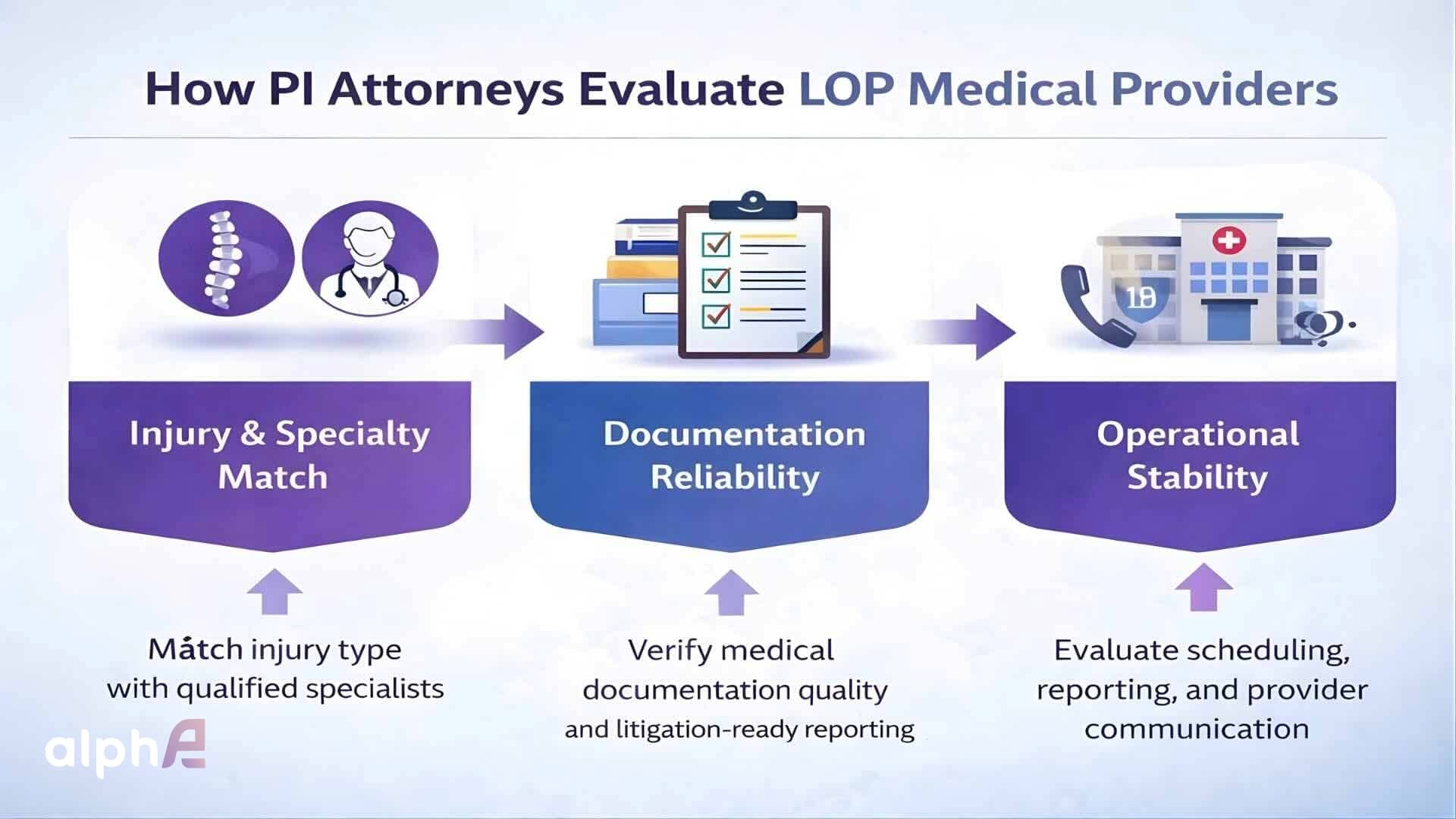
For that reason, experienced PI attorneys do not evaluate providers based solely on payment flexibility. Instead, they examine clinical capability, documentation reliability, and operational efficiency before making referrals.
How to Vet LOP Medical Providers Before Sending a Referral
Understanding the process of vetting LOP medical providers requires a structured evaluation framework. Attorneys should examine three key areas before choosing a provider: credentials, injury specialization, and administrative reliability.
Verify Licensing and Professional Credentials
The first step in vetting any provider is confirming that the physician is properly licensed and practicing in good standing. This helps ensure the provider meets professional standards and has not faced disciplinary action.
Physician licenses in Texas can be verified through the Texas Medical Board. Attorneys can also confirm provider credentials through the CMS National Provider Identifier Registry, which lists professional classifications and specialties.
Key steps include:
- Confirm that the provider’s medical license is active
- Review any disciplinary history or restrictions
- Verify the physician’s specialty classification
Completing these checks only takes a few minutes but can prevent significant referral problems later in the case.
Another useful practice is periodically reviewing the credentials of providers already in a firm’s referral network. Even trusted providers should be reevaluated occasionally to ensure licensing status and professional standing remain current.
Match the Provider to the Injury Type
Another essential step in vetting providers is ensuring that the provider’s specialty aligns with the client’s injury.
Not every injury should begin treatment with the same type of provider. Soft tissue injuries may be treated effectively through rehabilitation or chiropractic care, while spinal injuries or neurological symptoms often require orthopedic or neurological evaluation.
Understanding how to choose a doctor who accepts a letter of protection means looking beyond payment arrangements and evaluating whether the provider is clinically appropriate for the injury.
When the wrong provider becomes the first point of treatment, the case can quickly lose direction. Diagnostic imaging may be delayed, referrals to specialists may come too late, and treatment documentation may fail to clearly connect the injury to the accident.
For example, when a patient with spinal injuries initially visits a clinic that lacks imaging capabilities, diagnostic delays can weaken both treatment outcomes and the legal claim.
A properly matched provider helps establish a coherent treatment path that strengthens both the medical and legal aspects of the case.
In practice, many PI firms maintain referral networks that include providers specializing in spinal injuries, traumatic brain injuries, or orthopedic trauma, each playing a different role within the firm’s treatment pathway.
Evaluate Administrative Responsiveness
Many attorneys focus on clinical expertise when choosing providers, but administrative reliability can be just as important. However, inefficient administrative processes can create significant complications for both attorneys and clients.
Providers who delay scheduling appointments or struggle to release medical records can slow the progress of the entire case.
Important questions attorneys should ask include:
- How quickly can new patients be scheduled?
- How are medical records and billing statements released?
- Who handles communication with attorneys?
This approach helps attorneys apply a consistent process when deciding how to vet LOP medical providers in future cases.
Risks of Unmanaged Medical Referrals in Personal Injury Cases
One of the most common problems with unmanaged medical referrals in personal injury cases is fragmented medical documentation.
When clients are referred to multiple providers without coordination, the resulting medical record can become fragmented and inconsistent. Each provider may document different aspects of the injury, but the overall narrative becomes harder to follow.
This fragmentation often leads to three major issues:
- Treatment gaps that weaken causation arguments
- Conflicting diagnoses from different providers
- Incomplete medical records during negotiations
Insurance carriers frequently use these inconsistencies to question causation, treatment necessity, and overall claim value.
alphaE discusses these risks further in its article on the hidden risks of unmanaged personal injury treatment .
By establishing a more structured referral process, attorneys can significantly reduce these issues and maintain stronger documentation throughout the case.
Another hidden risk is delayed specialist referrals. When the initial provider lacks experience with injury cases, necessary diagnostic tests or specialist consultations may occur much later than they should. This delay can affect both recovery and documentation quality.
What Strong LOP Providers Typically Have in Common
Experienced PI attorneys often notice that their most reliable providers share several common characteristics.
These providers understand both the clinical and legal aspects of injury treatment.
Clear Medical Documentation
Reliable providers produce detailed medical records that clearly document patient history, injury symptoms, and treatment progression.
This documentation helps connect the injury to the accident and strengthens the medical evidence needed during negotiations or trial preparation.
Efficient Record Management
Strong providers maintain organized administrative systems that allow medical records and billing statements to be released quickly when authorized.
The U.S. Department of Health and Human Services has emphasized that patients have a legal right to access their medical records. Providers who respect this standard tend to work more effectively with attorneys.
Ability to Coordinate with Specialists
Complex injuries often require collaboration between multiple specialists. Reliable providers understand when to refer patients for imaging, orthopedic evaluation, or neurological consultation.
Instead of allowing treatment to drift, these providers help guide patients through a structured care pathway.

Building a Reliable Medical Provider Network
Over time, successful PI firms develop trusted networks of medical providers who understand injury documentation requirements and consistently deliver reliable treatment.
Strong provider networks also make it easier for firms to apply a consistent process for how to vet LOP medical providers across every case.
Over time, practices change, staff members move on, and treatment approaches evolve.
For many PI firms, the hardest part of medical referrals isn’t finding a provider who accepts a Letter of Protection, it’s finding one who will document injuries clearly, move treatment forward, and strengthen the case rather than complicate it, move treatment forward and strengthen the case rather than complicate it.
That’s exactly where structured provider networks make a difference. Instead of relying on trial-and-error referrals, firms can work with vetted providers who understand both injury treatment and the documentation standards required in litigation.
If your firm is looking for a more reliable way to manage referrals, reduce treatment gaps, and strengthen medical documentation from the start, you can explore how AlphaE helps PI attorneys reduce referral risk and improve case documentation here: https://www.alphae.marketing/
Conclusion
For personal injury attorneys, knowing how to vet LOP medical providers can directly influence the strength of an injury case. The provider chosen early in a case often shapes treatment timelines, documentation quality, and the medical evidence behind the claim.
When attorneys evaluate licensing, injury specialization, and administrative reliability, they reduce treatment gaps and avoid documentation issues insurers often exploit. A structured referral process also helps firms apply a consistent framework for how to vet LOP medical providers while avoiding the documentation issues and unmanaged referrals that often weaken injury claims.
Learning how to choose a doctor who accepts a Letter of Protection is not just about payment flexibility. It means working with providers who understand injury treatment, produce reliable medical records, and support both patient recovery and litigation strategy.
For firms building stronger referral systems, coordinated provider networks offer a more reliable way to reduce referral risk, improve documentation quality, and maintain better case control. Platforms like alphaE help PI attorneys connect with vetted LOP-friendly providers who understand both treatment standards and the documentation requirements of injury cases.