
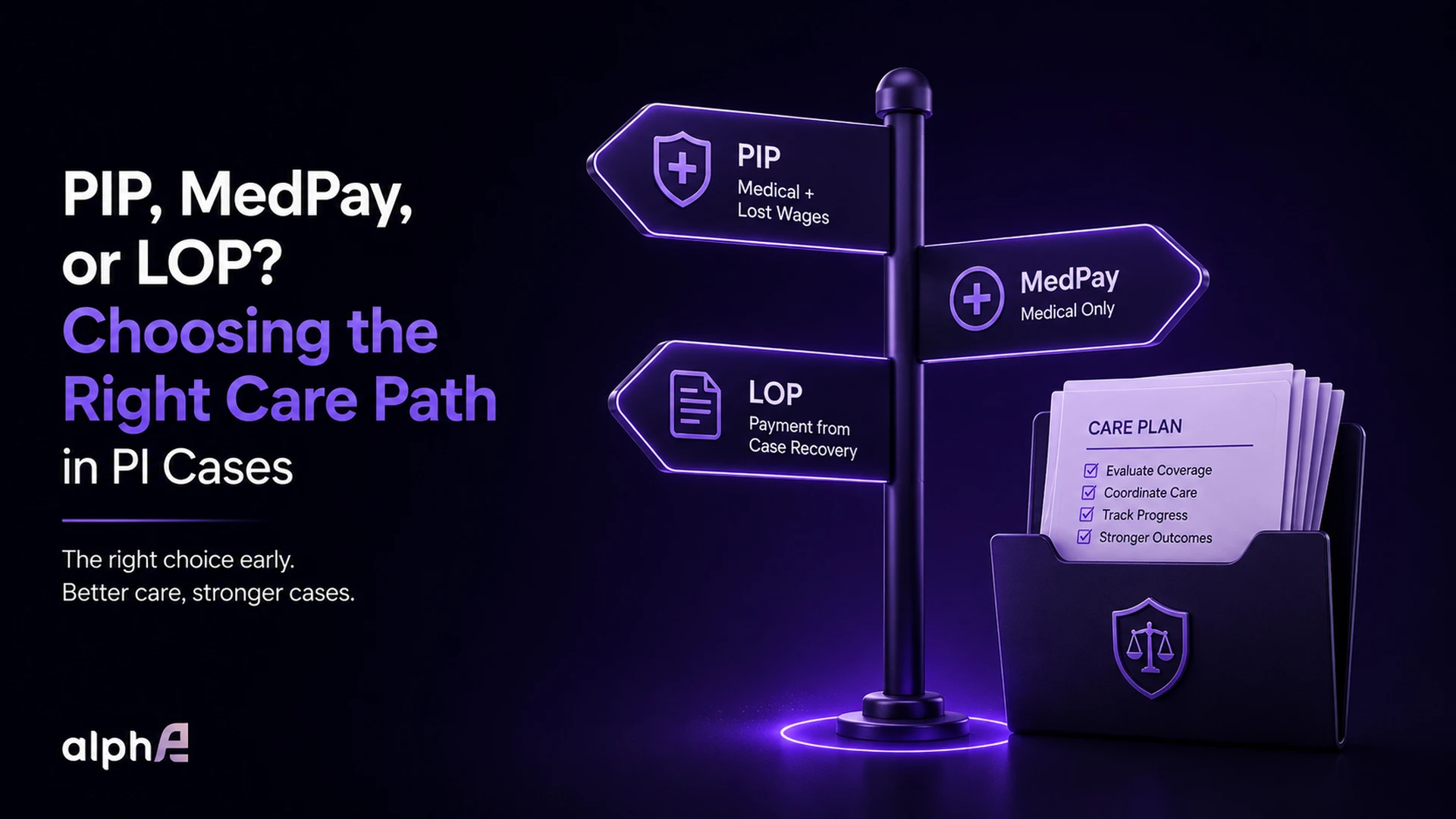
PIP, MedPay, or LOP is one of the earliest decision points in a personal injury case, and it usually shapes how the medical side of the file develops. PIP and MedPay are insurance-based options that may be available through a client’s own auto policy. A letter of protection is a separate coordination tool that helps an injured client access care when payment is expected from a future recovery.
For PI law firms, the distinction matters because each path affects which providers accept the case, how quickly the client is scheduled, and how billing status reads later. When a case manager is unsure which option applies, the team may default to one path while overlooking benefits the client could have used first.
This article looks at how PI firms can evaluate the right care path at intake, where each option helps, and what case managers should track to keep the file from becoming confusing during settlement review.
Why PIP, MedPay, and LOP Aren’t Interchangeable in PI Cases
PIP and MedPay are insurance benefits. A letter of protection is not. That basic distinction is where most workflow confusion starts.
PIP coverage usually pays medical expenses and a portion of lost wages regardless of fault, up to the policy limit. MedPay covers medical expenses regardless of fault but does not include wage replacement. Both come from the client’s own auto policy. A letter of protection is different: the provider agrees to treat with payment expected from the case recovery rather than at the time of service.
In practice, PIP MedPay or LOP is not a choice between three similar things. It is a choice between two insurance products and one coordination strategy.

What PIP Covers and Where It Helps Early in PI Cases
PIP is often the most useful personal injury medical payment option when available. The client has paid the premium, the coverage usually does not depend on fault, and the funds typically apply early.
Texas Insurance Code Chapter 1952 addresses personal injury protection in motor vehicle policies. The Texas Department of Insurance describes PIP as coverage that pays for medical and certain other expenses for the policyholder and passengers, regardless of who caused the accident.
PIP funds can help cover initial ER visits, imaging, or follow-up care while the larger case develops. When PIP is not identified at intake, the client may instead start care under an LOP that was not necessary at that stage. This shows up often in car accident injury cases, where auto-policy benefits are available but not always flagged.
PIP Is Usually First but Often Underused
One common breakdown happens when no one asks the right question at intake. The client mentions auto insurance, the firm confirms a policy exists, and PIP coverage never gets specifically verified. Weeks later, the team is coordinating LOP-based treatment for charges PIP could have absorbed. That is not a billing detail; it is a workflow visibility issue.
How MedPay Personal Injury Claim Coverage Differs From PIP
MedPay personal injury claim coverage looks similar to PIP on the surface, but the operational differences matter once the firm starts coordinating care.
MedPay generally covers medical expenses only no lost wages, no household services. It also tends to be a smaller add-on with lower limits. The firm may discover MedPay available on a policy even when the client said they had no auto insurance benefits.
For some clients, MedPay is the only insurance-based option available. In other cases, it stacks with PIP, health insurance, or another driver’s liability coverage. Treating MedPay personal injury claim coverage as identical to PIP can leave wage-related recovery questions unanswered.
MedPay Without PIP Limits Lost-Wage Recovery
When MedPay is the only auto-policy benefit available, the firm needs to be clear with the client about what is and is not covered. The client may assume any payment from the auto carrier handles their full impact including missed work when MedPay only addresses medical bills. Choosing the right medical care path in a PI case starts at intake includes setting expectations about which costs each coverage actually addresses.
When a Letter of Protection Becomes the Right Care Path
A letter of protection is not a substitute for insurance. It is a coordination tool used when insurance is unavailable, exhausted, or not appropriate for the specialty care the client needs.
In PI workflows, LOPs often help clients access orthopedic care, pain management, imaging, or specialty treatment when PIP and MedPay limits are reached or were not included in the policy. The provider agrees to treat with payment expected from the case recovery, which gives the client a clinical pathway forward.
A practical LOP workflow requires more than a signed document. It needs referral coordination, provider acceptance, scheduling, communication, and documentation follow-up. When LOP-based care is used as a fallback because PIP or MedPay was overlooked, the burden grows without reason.
The distinction also matters separately from any hospital lien that may already exist on the file. Firms tracking letter of protection vs hospital lien issues need to keep LOP-based treatment, insurance benefits, and prior hospital charges visible as three separate billing stories not one blended balance.
How to Evaluate Personal Injury Medical Payment Options at Intake
Intake is where PIP MedPay or LOP is either set up well or set up to fail. A strong intake step should surface every personal injury medical payment option available before treatment is coordinated.
A practical intake review should answer:
- whether the client has an active auto policy with PIP coverage
- whether MedPay is included on the same or another vehicle policy
- whether health insurance is available and how it interacts with PIP and MedPay
- whether the client may need specialty care the available coverage cannot reach
When those answers are visible early, the team can sequence care intentionally instead of reacting later.

Some Cases Need All Three Paths in Sequence
In some PI cases, the right answer is not PIP, MedPay, or LOP it is PIP first, then MedPay, then LOP. PIP funds cover initial care. MedPay extends coverage. LOP supports specialty care after both are exhausted. That layered approach only works when the firm sees the full coverage picture at intake.
Where Choosing the Wrong Care Path Creates File Problems
The cost of choosing the wrong care path is rarely visible right away. It usually surfaces during records review, billing reconciliation, or settlement preparation.
Consider a client who started orthopedic care under an LOP because the intake team assumed there was no insurance benefit. Months later, the firm learns that the client’s spouse’s auto policy included MedPay that would have covered the early visits. By then, the LOP balance is built around bills that did not need to be deferred, and the settlement math has to be redone.
That kind of rework is preventable, but only when PIP MedPay or LOP is examined as a unified question instead of three separate ones. The same logic applies in reverse: a client who runs out of PIP funds mid-treatment should not lose access to care because nobody coordinated an LOP transition.
What Case Managers Should Track Across PIP, MedPay, and LOP
Case managers do not have to be insurance specialists. They do need to keep the coverage picture visible so the attorney has a clean read when they look at the file.
A useful coverage view should show:
- which personal injury medical payment options were verified at intake
- how PIP, MedPay, and LOP funds are being applied across providers
- when any coverage source is approaching its limit
- which providers are billing through insurance versus under an LOP
This becomes part of the same coordination discipline that strengthens provider referrals for PI law firms, where intake quality determines whether the medical timeline holds together.
Coverage Status Should Be Visible Before Records Pile Up
When PIP MedPay or LOP status only lives in scattered intake notes, the team has to reconstruct it later. That reconstruction usually happens under pressure around settlement preparation, and it can surface gaps that should have been caught months earlier.
How Better Coordination Helps PI Firms Choose the Right Care Path
Better coordination does not rewrite how PIP, MedPay, or LOP works. It makes the choice visible at the moment when it shapes the file. A stronger workflow connects intake coverage review with provider matching, referral coordination, and documentation follow-up, so care paths line up with case strategy instead of drifting between loose options.
Frequently Asked Questions About PIP, MedPay, or LOP
What is the main difference between PIP, MedPay, and LOP?
PIP and MedPay are insurance benefits available through a client’s own auto policy. A letter of protection is not insurance it is a coordination tool where a provider agrees to treat with payment expected from a future case recovery.
Should PIP, MedPay, or LOP be used first in a PI case?
In most cases, available insurance benefits are used before LOP-based care is coordinated. PIP and MedPay can apply early regardless of fault, while a letter of protection is appropriate when insurance is unavailable, exhausted, or does not reach the specialty care needed.
Can a PI client use PIP, MedPay, and LOP in the same case?
Yes. Some PI cases involve all three paths in sequence PIP for initial care, MedPay for additional coverage, and a letter of protection for specialty treatment after insurance benefits are exhausted.
How does MedPay personal injury claim coverage differ from PIP?
MedPay personal injury claim coverage generally pays only medical expenses, while PIP often includes a portion of lost wages and related costs. MedPay limits are also usually lower, and the coverage may stack with PIP rather than replace it.
What happens if a PI firm chooses the wrong care path?
Choosing the wrong care path can create billing confusion, build LOP balances on charges insurance could have absorbed, or leave specialty care unfunded. The file may later require reconciliation under settlement pressure.
Final Takeaway
PIP, MedPay, or LOP is not a label question; it is a workflow question. The choice shapes which providers accept the case, how quickly the client gets into care, what the billing picture looks like at settlement, and how clearly the file reads when someone needs to explain the treatment story.
Choosing medical care path PI case strategy at intake keeps the file consistent. PIP and MedPay are evaluated as insurance options, an LOP is coordinated when the situation calls for it, and the team has a unified view of how all three are applied.
Need a clearer way to coordinate PIP, MedPay, and LOP-based care? alphaE helps Texas PI law firms connect intake coverage review with provider matching, scheduling visibility, and documentation follow-up from the first appointment through settlement review.