
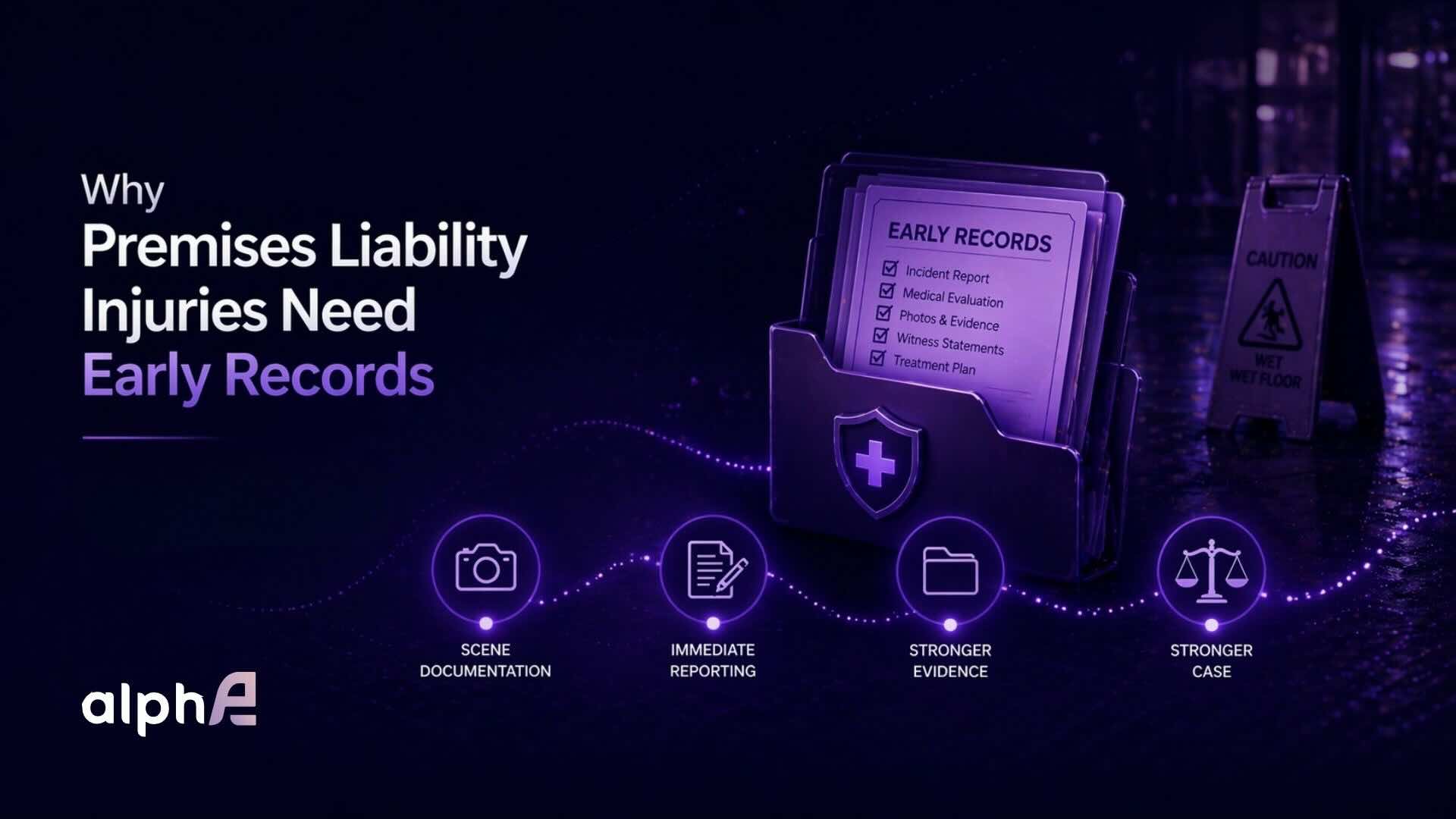
Premises liability medical documentation plays a critical role in how injury claims are evaluated and defended. In these cases, the strength of the claim often depends on how clearly the medical record connects the incident to the client’s symptoms, treatment, and progression.
While a premises case may seem straightforward at intake, that clarity can quickly break down when treatment is delayed or documentation lacks structure. Gaps in early records often lead to inconsistencies, unclear timelines, and avoidable challenges around causation.
For Personal Injury attorneys, early medical documentation does more than confirm that treatment occurred. It helps establish when symptoms began, how the injury happened, and whether the clinical record stays consistent as care progresses. In many premises liability cases, the quality of these early records shapes how clearly the entire case can be understood and presented.
How Premises Liability Medical Documentation Establishes the Timeline
The first records usually become the baseline for the entire claim. They capture where the incident happened, how the client fell or was hurt, what symptoms appeared right away, and what providers observed before the case narrative had time to blur. In premises cases, that timing matters because the defense often looks for any chance to argue that the condition was minor, unrelated, or exaggerated.
When early documentation is delayed, several problems start at once:
- The client’s symptom history may look less precise than it actually is.
- The mechanism of injury may be described differently across later visits.
- The defense gets more room to argue that another event caused the complaints.
At that stage, documentation is no longer just routine paperwork; it becomes one of the clearest ways to connect the injury to the event.
It preserves the first medically relevant version of the event and helps prevent the file from being reconstructed later from incomplete memory. Early documentation also makes it easier to compare the initial complaints with later imaging results and functional limitations.
Premises cases often rise or fall on consistency
Unlike some injury claims, premises cases often involve disputed facts from the beginning. Property owners may deny notice, dispute the severity of the hazard, or argue that the injured person simply mis stepped.
A strong early record usually helps in four ways:
It ties symptoms to the incident date
When the first evaluation happens promptly, the chart is more likely to reflect when pain began, what body parts were involved, and whether the client described immediate swelling, instability, dizziness, or loss of function. That timing helps keep medical evidence in premises liability claims anchored to the incident instead of floating across later assumptions.
It shows the injury pattern before treatment becomes fragmented
Premises injuries are rarely limited to a single note. A client may need urgent care, imaging, orthopedic review, rehabilitation, or pain management. Without early structure, each provider can end up documenting only part of the picture. Clear premises liability injury evaluation records at the front end make later records easier to interpret as part of one clinical progression.
It reduces avoidable contradictions
Minor inconsistencies are common in real medical files, especially when multiple providers document the same injury from different clinical angles. What hurts a case is not ordinary variation but avoidable confusion. If one note says the client landed on the left side and a later note emphasizes only back pain, the defense may treat that as a credibility problem even when it is clinically explainable. Early documentation gives later records a clear baseline to reference.
It makes follow-up care easier to understand
When a case starts with organized records, referrals, imaging orders, work restrictions, and specialist recommendations read like a sequence instead of disconnected events.

What early records should capture in a premises injury case
Early records do not need to sound dramatic. They need to be clear. They do not need to exaggerate the injury; they simply need to reflect what was reported and what was observed while the details are still fresh.
The most useful early elements usually include:
- The mechanism of injury and the setting in which it occurred
- Immediate symptoms, affected body regions, and pain behavior
- Objective findings from the first exam
- Functional limitations, work restrictions, or mobility changes
- The need for imaging, referral, follow-up, or continued monitoring
This is where premises liability injury documentation and structured early evaluation begin to work together. One preserves the initial account and clinical findings. The other helps create a path for what needs to be evaluated next.
Why Delayed Care Creates Complications in Premises Liability Claims
Delays in treatment do not automatically weaken a premises liability claim, but they often make the medical record harder to interpret and defend. When care does not begin promptly, the connection between the incident and the reported symptoms becomes less clear, even if the injury itself is legitimate.
In practice, delayed care creates three recurring challenges:
- The timeline between the incident and the onset of symptoms becomes less defined
- Causation is easier for the defense to question or dispute
- Later medical records can appear reactive rather than tied directly to the original event
Once a gap exists, the record has to account for it. Explanations may be valid such as access issues, scheduling delays, or uncertainty about injury severity but from a legal standpoint, gaps still introduce ambiguity.
More importantly, delayed care often leads to delayed documentation. Without early clinical records capturing the mechanism of injury, initial symptoms, and first observations, the case begins to rely more heavily on reconstructed narratives instead of contemporaneous medical evidence.
For this reason, early treatment is not just a clinical step; it is a documentation anchor. The sooner care begins, the easier it is to preserve a clear and consistent medical timeline that supports both treatment decisions and case development.
Early documentation supports both treatment and case value
Good records do more than support settlement value; they also make the treatment timeline easier to understand clinically and legally.
In premises cases, this matters because the full extent of an injury is not always obvious during intake. A fall may involve orthopedic trauma, soft tissue injury, aggravation of a prior condition, or delayed recognition of a more serious issue. When the early file is organized, premises liability injury evaluation records can show how the case evolved instead of making later care look unrelated.
For firms handling these cases regularly, coordinated referrals matter for the same reason. This kind of treatment coordination is especially useful in cases where injury progression needs to remain clear across multiple providers and stages of care. That emphasis reflects how many firms already view medical documentation in these cases as something that keeps the medical narrative clear and connected, rather than just routine paperwork.
What attorneys should watch for in the first 30 days
The first month usually tells you whether the medical file is developing in a way that will stay understandable later. Attorneys do not need to direct medical care, but they do need to notice when the record is getting thin, scattered, or slow.
A practical first-30-day review should focus on:
Whether the first visit clearly describes the event
If the mechanism is missing or vague, later providers may document only symptoms without tying them back to the premises event in a useful way. That weakens medical evidence in premises liability claims long before settlement discussions begin.
Whether the complaints and findings stay aligned
Symptoms can evolve, but the file should still read like one injury sequence. If the early note, follow-up, and referral path seem disconnected, the problem is usually not the patient. It is that the record lacks structure.
Whether referrals and imaging happen on a reasonable timeline
Unexplained delay can make legitimate injuries harder to present. Strong early recordkeeping does not require every answer on day one, but it does require progression from complaint to evaluation to next step.
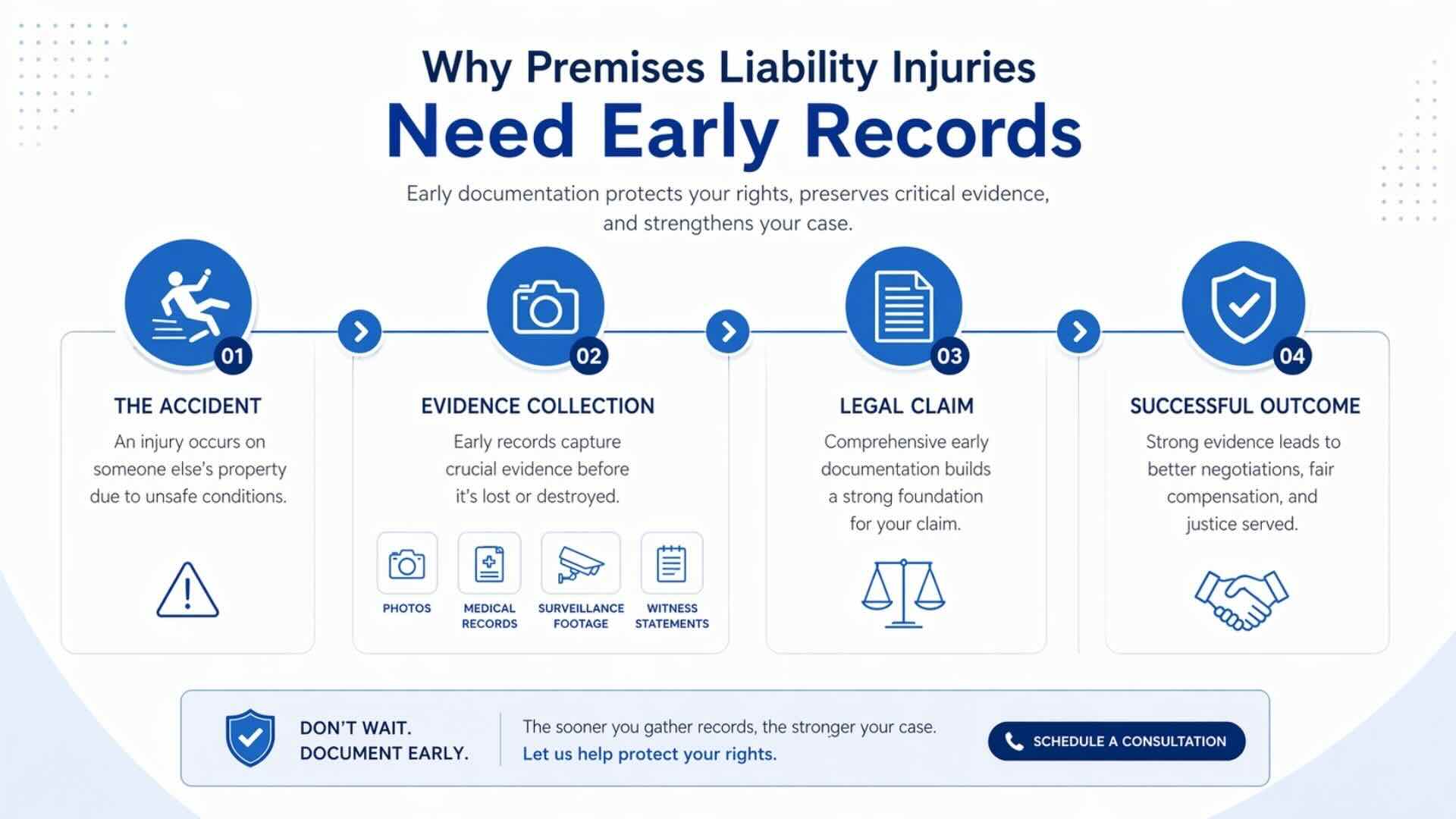
Early coordination keeps the record usable
Premises claims often become harder not because the injury disappeared, but because the medical story stopped reading as one continuous sequence. Once care is delayed, referrals are slow, or records come back incomplete, the case starts losing clarity in ways that are difficult to fix later. Medical documentation is most valuable when it captures the first phase of care clearly enough for later providers to build on it.
That is also why these files benefit from early coordination. When providers, scheduling, and follow-up are managed with discipline, it becomes easier to maintain consistent records, reduce unnecessary gaps, and preserve the relationship between the incident and the treatment path. Firms that want a clearer sense of why orthopedic follow-up matters can look to related educational content that shows how continuity of care affects documentation quality and case clarity.
Conclusion
Premises liability claims rarely improve with time. When early medical documentation is delayed or inconsistent, the case quickly loses clarity.
Strong early records establish timeline, causation, and consistency making the case easier to support and present. This starts with timely care and structured coordination.
alphaE helps Texas PI attorneys coordinate LOP-based treatment, scheduling, and documentation so cases begin with a clear, reliable medical timeline.