
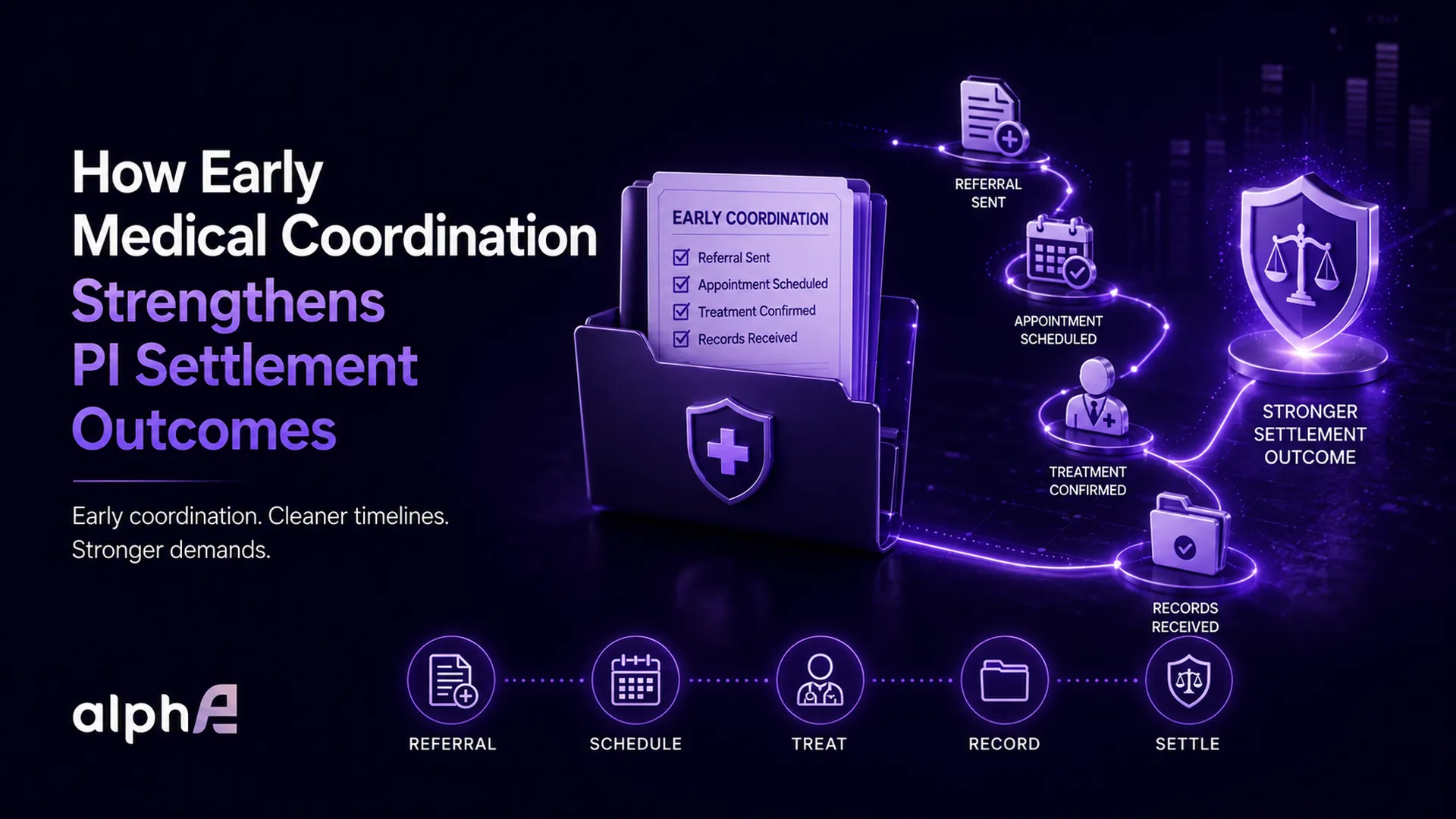
Early medical coordination in PI settlement work often determines how strong a case looks long before a demand is written. The settlement record is shaped in the first few weeks after the injury, when referrals are made, appointments are scheduled, treatment begins, and the first specialist notes enter the file.
For PI law firms, that early window can create a clean medical timeline or leave small gaps that become difficult to explain later. A client who is referred promptly, seen quickly, and tracked through the first month produces a file that reads as organized and credible.
What Early Medical Coordination Covers
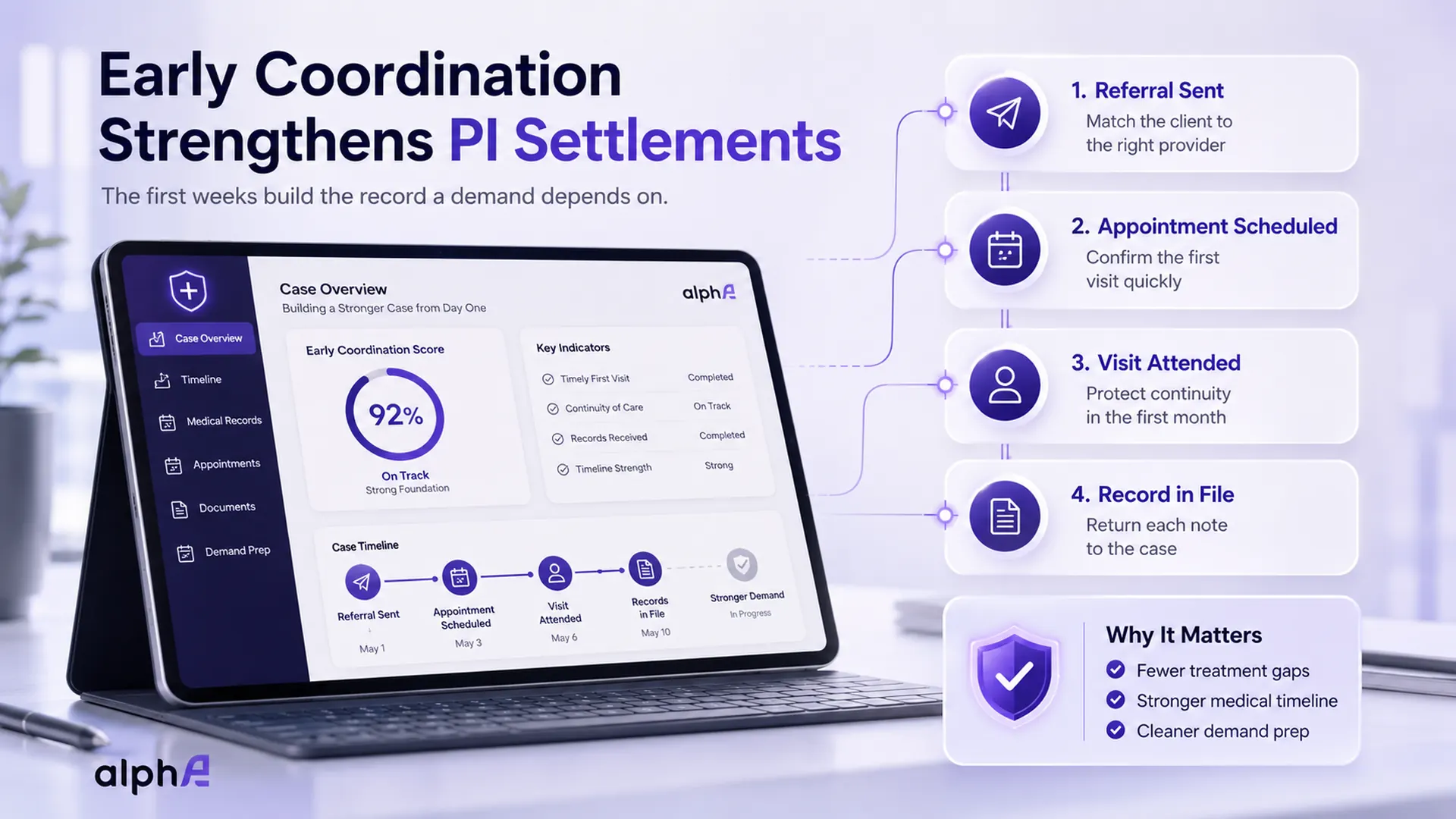
The work in the first weeks is not a single task. It is the set of handoffs that move a client from injury to active, documented treatment: matching the client to the right provider, confirming the first appointment, and making sure each visit produces a record that reaches the file.
In practice, the first weeks touch four things: the referral, the scheduling, the client’s attendance, and the note or report returning to the case. The value is in keeping those steps connected so the file has evidence, not just activity.
Why the First Weeks Carry the Most Weight
The opening weeks after an injury do more for a case than any later stretch of treatment. This is when the link between the incident and the injury is easiest to establish, and when a clean sequence of care is easiest to build.
An adjuster reviewing a demand reads the early record closely. A client who sought care within days, followed the first referral, and kept the initial appointments presents a straightforward story. A first specialist visit three weeks after the injury invites a different reading, where the gap suggests the injury was minor or treatment was delayed.
For car accident injury cases, where the mechanism of injury may be clear but severity is contested, this early stretch helps keep the medical narrative from becoming a negotiating weakness.
Where Early Coordination Gaps Start
Most early gaps form in the handoffs between referral, scheduling, attendance, and record collection. The referral may be written, but not scheduled. The appointment may be offered, but not confirmed. The visit may happen, but the note may never make it back into the file.
The problem is that the settlement record does not explain intent. It shows dates. A referral that was made promptly but scheduled slowly can look the same as delayed care. That is why medical referral coordination in PI cases is not only about moving quickly. It is about making sure the file reflects what actually happened, when it happened, and how each step connected to the next.
How Treatment Progress Builds the Settlement Timeline
A settlement demand rests on a timeline, and a timeline is only as strong as the progress behind it. Each visit, referral, and follow-up is a data point, and coordinated care is what keeps those points connected in a line rather than scattered across providers.
When a firm can see PI case treatment progress as it happens, the settlement timeline builds itself. Each completed visit closes a loop, each new referral opens the next one, and the record grows in step with the treatment. The alternative is reconstructing that sequence at demand time from scattered records requests, which is slower and more likely to surface gaps that were never explained.
Continuity Is Easier to Protect Than to Rebuild
Continuity in a medical record is fragile in the moment and expensive to recover later. A missed appointment noticed the same week can be rescheduled before it becomes a gap. The same missed appointment discovered during demand prep is already a documented interruption that needs a reason attached to it.
Tracking treatment progress early means the firm is protecting continuity as it forms, not trying to rebuild it under settlement pressure. That is the difference between a timeline that reads cleanly and one that reads with footnotes.
What PI Firms Should Coordinate in the First Weeks
Case managers do not need to manage medicine. They need to make sure the medical steps are moving and being recorded. In the first weeks, that means keeping a small set of things visible rather than assuming they resolved on their own.
A practical early-status view should track:
- whether each referral has been scheduled, not just written
- whether the first appointment was confirmed and attended
- whether the visit produced a record that reached the file
- whether the next referral in the sequence has been initiated

The Early Status Points Worth Owning
These points matter early because each one is cheap to fix in week one and costly to fix in month six. A referral that stalled can be rescheduled in a day if the firm sees it. The same stalled referral found later means a gap that is already baked into the record.
Owning these status points does not mean micromanaging providers. It means the firm always knows where each client sits in the treatment sequence, so no one has to reconstruct that position under deadline.
What a Strong Early Coordination System Should Show
A strong early coordination process gives the case team a live view of where each client stands in the treatment sequence. For every active PI case, the firm should be able to see which referral is pending, which appointment is scheduled, whether the client attended, whether documentation has been received, and whether the next medical step has been opened.
That visibility matters because PI settlement medical documentation is built from small confirmations throughout the case, not one final records request. When those confirmations are tracked early, the demand package is easier to prepare and treatment gaps are less likely to surprise the attorney during settlement review.
How Early Coordination Strengthens PI Settlement Medical Documentation
Everything organized in the first weeks eventually surfaces in one place, the demand package. A file built on continuous care produces a demand that reads as a clear medical story. A file built on scattered, partially documented care produces a demand the firm has to defend before it can even present.
Strong medical referral handoffs show up as documentation that closes its own loops. This is where early medical coordination in PI settlement work becomes visible: the file shows a connected path from referral to treatment to documentation.
The referral has a matching visit. The visit has a matching record. The record connects to the next step. When an adjuster reviews that kind of PI settlement medical documentation, there is little to question about the treatment timeline, which keeps the negotiation focused on the value of the injury rather than the gaps in the record.
The reverse is expensive. When that early work is thin, the firm spends demand prep chasing missing reports, explaining intervals, and requesting records that should already be in hand. The settlement conversation then starts from a defensive position that stronger early work would have avoided.
Case Study: Same Injury, Different File
Consider two clients injured in similar rear-end collisions the same week, both reporting neck and lower-back pain. The medical facts are close, but the file quality is not:
| Timeline Factor | Client A (Uncoordinated Care) | Client B (Coordinated Care) |
| Orthopedic Referral | Sits unscheduled for 9 days. | Scheduled within 48 hours. |
| First Specialist Visit | Lands 24 days after the injury. | Happens on day 6. |
| Imaging & Reports | Ordered 2 weeks later; reports missing at demand. | Ordered and read the following week; routed to file instantly. |
| Adjuster’s Perception | Delayed/minor injury; gap-filled timeline. | Continuous, real-time documented care. |
Frequently Asked Questions About Early Medical Coordination
Why does early medical coordination matter so much for PI settlements?
Early coordination matters because the settlement record is largely built in the first weeks after an injury. A clean early sequence of care helps protect the medical timeline from gaps that weaken the demand later.
What should PI firms coordinate in the first few weeks?
Firms should confirm that each referral is scheduled and attended, each visit produces a record, and the next referral in the sequence is initiated.
How do early treatment gaps affect a settlement?
Early gaps can make the medical timeline look weaker. An unexplained delay between injury and treatment may suggest minor injury or delayed care, giving an adjuster a reason to question the demand.
Does early coordination speed up settlement?
It can reduce friction at demand time. When records are already in the file, the firm spends less time chasing reports and explaining gaps.
How does early medical coordination support PI settlement medical documentation?
It helps make sure referrals, appointments, treatment notes, imaging reports, and follow-up records are collected as the case develops, creating a cleaner timeline before demand preparation.
Final Takeaway
Early medical coordination strengthens PI settlement outcomes because the file that settles a case is built long before anyone writes the demand. The referrals, appointments, and records from the first weeks are what the timeline is made of, and coordination is what keeps them connected.
For Texas PI law firms, the practical move is to treat the first month of care as the most important documentation period of the case. Referrals should be scheduled, appointments should be confirmed, records should return to the file, and each next step should be visible before the case reaches demand preparation.
alphaE helps PI law firms strengthen early medical coordination, monitor PI case treatment progress, and support PI settlement medical documentation from intake through settlement review. With better visibility across referrals, appointments, and records, firms can reduce avoidable gaps and build cleaner settlement timelines.