

A broken medical referral handoff process can delay treatment, disrupt documentation, and create unnecessary risk for personal injury law firms. When provider communication, appointment scheduling, or follow-up ownership is unclear, referrals often stall before treatment even begins.
For personal injury (PI) firms, the handoff is more than an administrative transfer. It connects intake, provider selection, appointment scheduling, treatment communication, and the medical records attorneys later rely on during the case. A strong PI referral handoff reduces ambiguity at the moment small missed details can turn into treatment delays. A standardized PI referral handoff also helps firms reduce scheduling gaps, communication errors, and referral tracking issues across multiple providers.
Why Medical Referral Handoffs Fail After Intake
Most referral problems do not come from one dramatic mistake. They usually come from ordinary gaps: a note buried in the case file, a provider’s office waiting for imaging, a client who misses a call, or a paralegal assuming someone else confirmed the appointment. A law firm referral process breaks down when referrals are passed along without clear follow-up responsibility.
More complex cases make those gaps easier to see. An auto collision client may need imaging before a specialist will review the file. A back injury may start with conservative care and then require pain management or spine evaluation. An orthopedic file may depend on getting records, reports, and follow-up recommendations into one place. Firms that work with a medical coordination partner such as alphaE are usually trying to reduce this exact friction: provider fit, scheduling, communication, and documentation need to stay coordinated throughout the process.
What the medical referral handoff process must capture
The goal is not to collect every detail in the file; it is to give the provider, scheduler, or coordination partner enough context to act without guessing. The personal injury referral workflow should make the handoff repeatable while leaving room for case-specific judgment.
A practical handoff captures the facts that determine whether the referral can be accepted, scheduled, and followed up without confusion:
- Client identifiers, preferred contact method, language needs, and any scheduling constraints that could affect appointment confirmation.
- Injury type, symptom pattern, accident context, and current treatment status, including whether the client has already seen another provider.
- Provider requirements, such as Letter of Protection (LOP) availability, specialty fit, location, imaging needs, and whether the next step is evaluation, therapy, pain management, or specialist review.
- Documents already available, including intake notes, prior treatment records, imaging orders, diagnostic reports, discharge paperwork, and provider recommendations.
- Ownership of the next action, with a clear due date and an escalation path if the provider, client, or referring staff member does not respond.
Clear referral details help providers, coordinators, and legal staff move the case forward without unnecessary delays or repeated follow-up.

Example Medical Referral Handoff Process for PI Firms
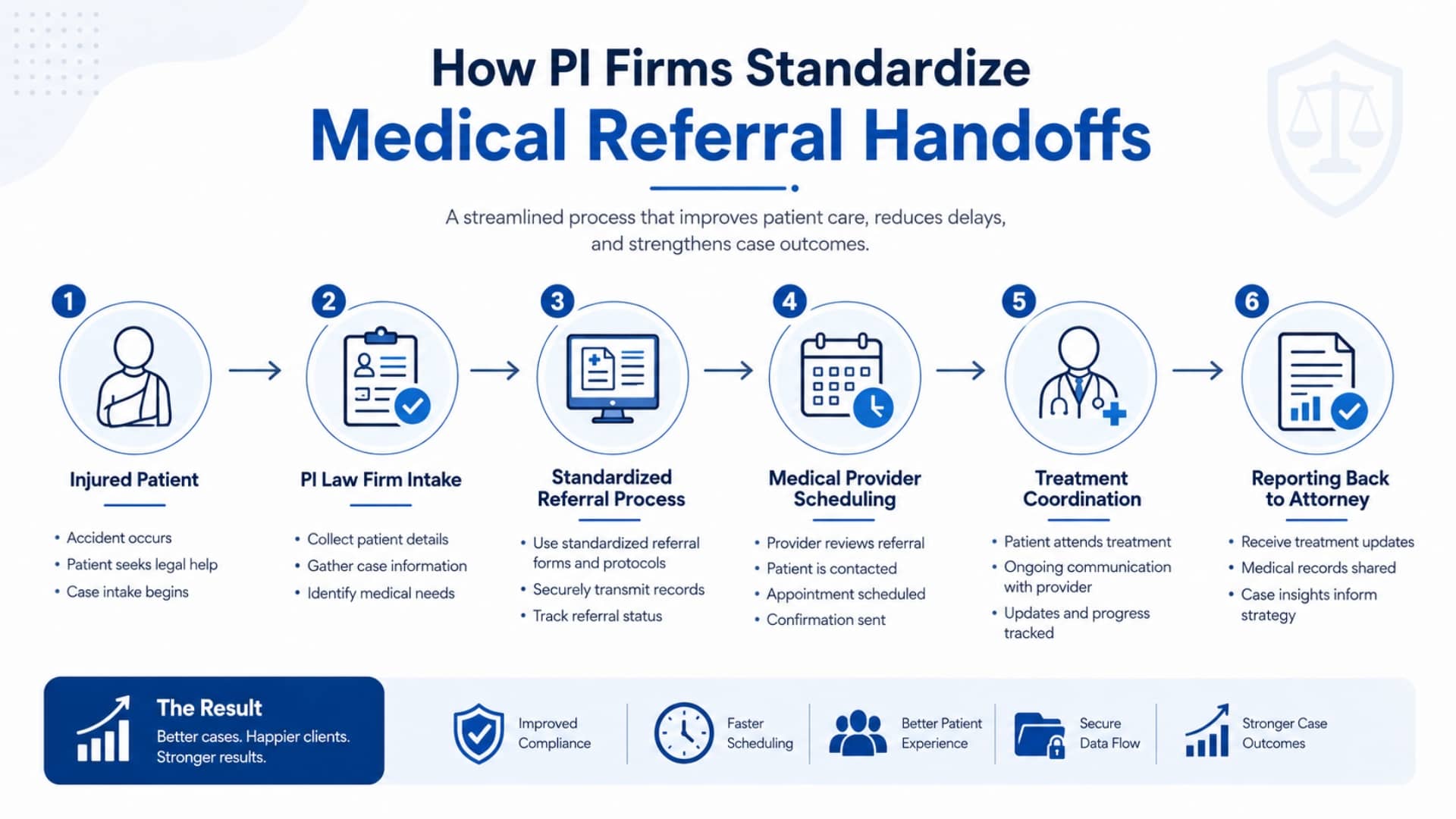
A standardized medical referral handoff process usually follows a clear sequence:
- Complete intake documentation and injury details.
- Match the client with the appropriate provider based on specialty, location, and LOP requirements.
- Verify whether imaging, records, or additional documents are required before scheduling.
- Send referral documents and confirm provider acceptance.
- Schedule the appointment and document confirmation details.
- Track treatment progress, provider recommendations, and follow-up care.
- Request and organize medical records, imaging reports, and treatment notes.
- Escalate delayed or stalled referrals to the responsible team member.
How PI Firms Standardize the Medical Referral Handoff Process
Each stage of the referral process should have one clearly responsible person. The team should know who prepares the referral, who sends it, who confirms acceptance, and who updates the client. It should also be clear who checks whether documentation is returned in a usable form.
Intake to provider match
The first transition is from case intake to provider selection. At this point, the firm is translating injury facts into a care path. A good PI referral handoff looks beyond proximity and focuses on provider fit, injury type, LOP requirements, and the likely treatment path. Reviewing supported personal injury case types can help teams think in categories instead of starting from scratch on every file.
At this stage, a personal injury referral workflow should separate medical need from administrative preference. The closest office is not always the right destination if the case needs imaging, orthopedic review, spine evaluation, or coordinated follow-up.
Provider match to scheduled appointment
Once a provider is identified, the handoff shifts from selection to execution. The law firm referral process should also define who verifies provider acceptance, sends the correct documents, confirms the appointment, and records the outcome in the file. This is where vague task notes cause trouble. “Sent to provider” is not the same as “provider accepted, client scheduled, appointment confirmed, next follow-up assigned.”
For example, a car accident injury coordination file may move through imaging, orthopedic evaluation, and therapy at different points. Without a defined handoff, each transition creates a new chance for delay.
Treatment start to documentation follow-up
The medical referral handoff process also needs a defined documentation track. Treatment may begin quickly, but the case still suffers if records, imaging reports, and provider recommendations are delayed or scattered. Firms handling orthopedic injury coordination often need a clear record of evaluation, follow-up recommendations, and whether additional care was ordered.
This is more than administrative cleanup. Documentation helps the legal team understand what happened medically, what is still pending, and whether the next referral step has been addressed.
Close the loop without burying the team in admin
Standardization should reduce follow-up work, not create another layer of busywork. The process only needs a few reliable confirmation checkpoints. Without a structured PI referral handoff, small communication failures can quickly turn into treatment delays or missing documentation. A PI referral handoff should leave evidence of acceptance, not just evidence that someone sent a message.
Strong teams usually close the loop around a few practical checkpoints:
- Referral received and accepted by the provider or coordination partner.
- Client contacted, appointment scheduled, and appointment details documented.
- Missed calls, missed appointments, or provider delays escalated to the right person.
- Treatment status updated after the first visit or next-step recommendation.
- Records, imaging reports, and treatment notes requested, received, and filed where the attorney or case manager can find them.
Teams do not need to track every small update, but they do need a way to catch stalled referrals early. When a referral stalls, the team should see it early enough to act.
Use a realistic scenario to test the workflow
To test whether a personal injury referral workflow works, test it against a common but messy case. A client reports neck and lower back pain after a crash. Intake notes are complete, but the client works nights, has not had imaging, and can only travel within a narrow area. The first provider accepts LOP cases but wants diagnostic imaging before considering a specialist referral.
In a disciplined handoff, the case manager does not simply forward the file and hope the pieces line up. The team records the scheduling constraint, sends the relevant intake notes, confirms the provider requirement, tracks the imaging step, and sets a follow-up date for the next recommendation. If the file later needs spine and back injury coordination, the next provider already has the necessary background information.
That is where the law firm referral process needs a standard escalation rule. If the client cannot be reached, the provider does not accept the referral, or the appointment is not confirmed within the expected window, the file should be escalated instead of left untouched. One person should be responsible for resolving the issue.
Review the medical referral handoff process before the case starts drifting
Teams improve the process faster when they review failed or delayed referrals instead of only completed ones. Look at files where appointments slipped, records arrived late, or the attorney could not tell what happened after the referral. Those files usually reveal the weak point: missing intake detail, unclear ownership, no confirmation step, or no documentation follow-up.
For firms refining a medical coordination model, standardization also makes outside support easier to use. A partner can help with provider access and scheduling, but the firm still needs internal clarity on what information leaves the office, what comes back, and who reviews it. That is especially true when the matter involves multiple specialties or staged care.
Conclusion
A well-managed medical referral handoff process gives the firm more than a cleaner task list. It gives attorneys and case teams better visibility into treatment progress, pending next steps, and documentation status. Just as important, it gives clients a clearer path from intake to care.
The most reliable medical referral handoff processes are simple, consistent, and built around clear ownership. Firms that improve referral visibility early can reduce treatment delays, improve provider communication, and keep documentation organized throughout the life of the case.
alphaE helps personal injury law firms streamline provider coordination, appointment scheduling, referral tracking, and medical documentation through a more reliable medical referral handoff process. Contact alphaE to improve referral visibility and reduce delays across your personal injury referral workflow.