
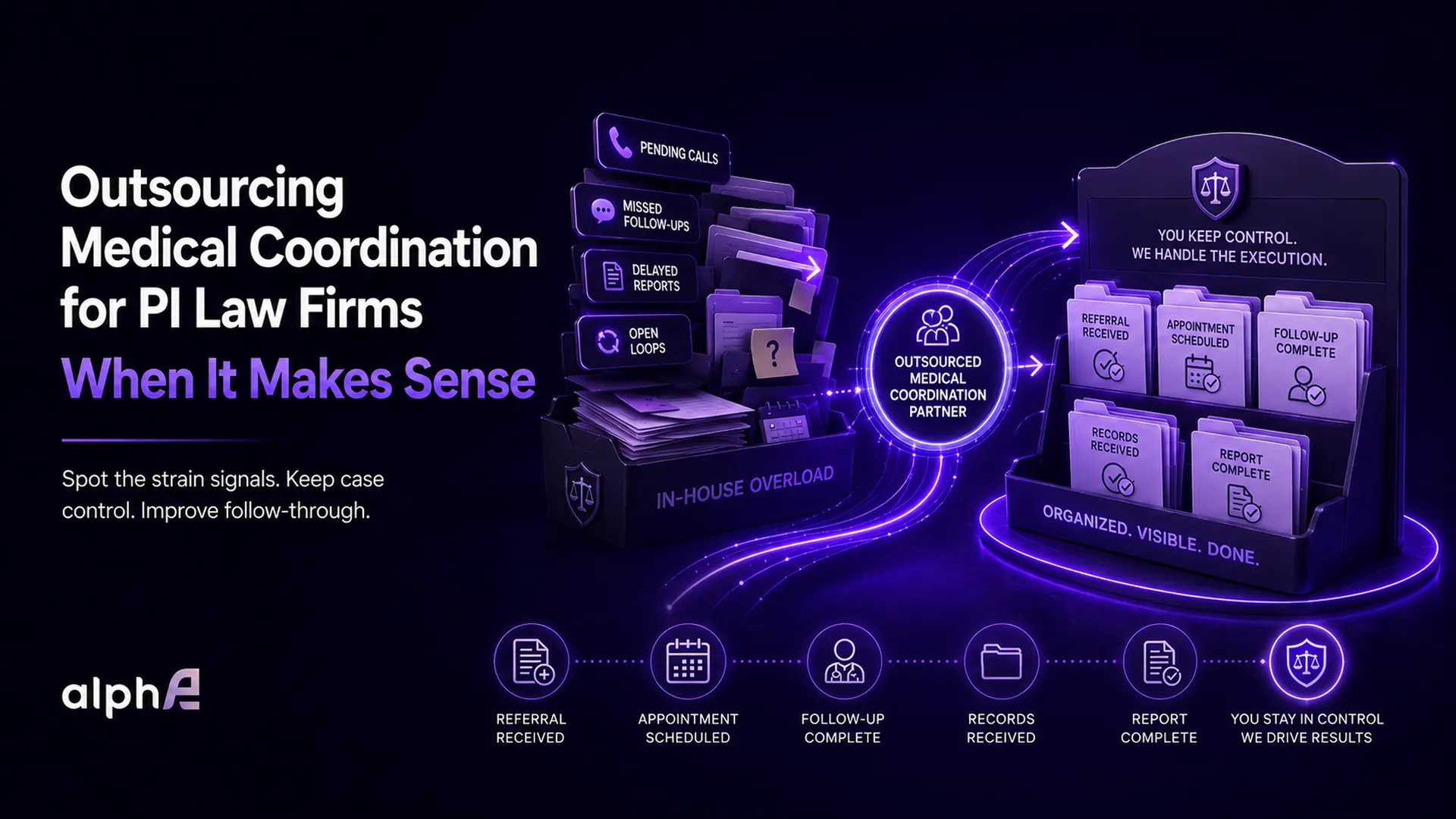
Outsourcing medical coordination for PI law firms usually becomes relevant after caseloads grow and case managers spend increasing time chasing appointments, scans, reports, and records.
Medical coordination connects a client’s treatment to the eventual demand package. When the process breaks down, firms face treatment gaps, delayed records, and last-minute work during settlement preparation.
This article explains when outsourcing makes sense, what the work covers, and how outside support can improve execution without taking case control away from the firm.
Why In-House Medical Coordination Reaches a Ceiling
Most firms initially handle medical coordination in-house. A case manager or paralegal tracks referrals, confirms appointments, contacts providers, and retrieves records.
The limitation is structural rather than personal. Each case creates open tasks a pending scan, an outstanding report, or an unscheduled referral that require attention at different times. As caseloads grow, these tasks become harder to track consistently.
The process rarely fails all at once. Less urgent follow-up simply gets delayed until demand preparation reveals a missing report or incomplete medical timeline.
What Medical Coordination Actually Involves
Before handing this work off, it helps to be precise about what the function covers. It is easy to picture it as booking appointments, but that is only one visible piece of a longer chain.
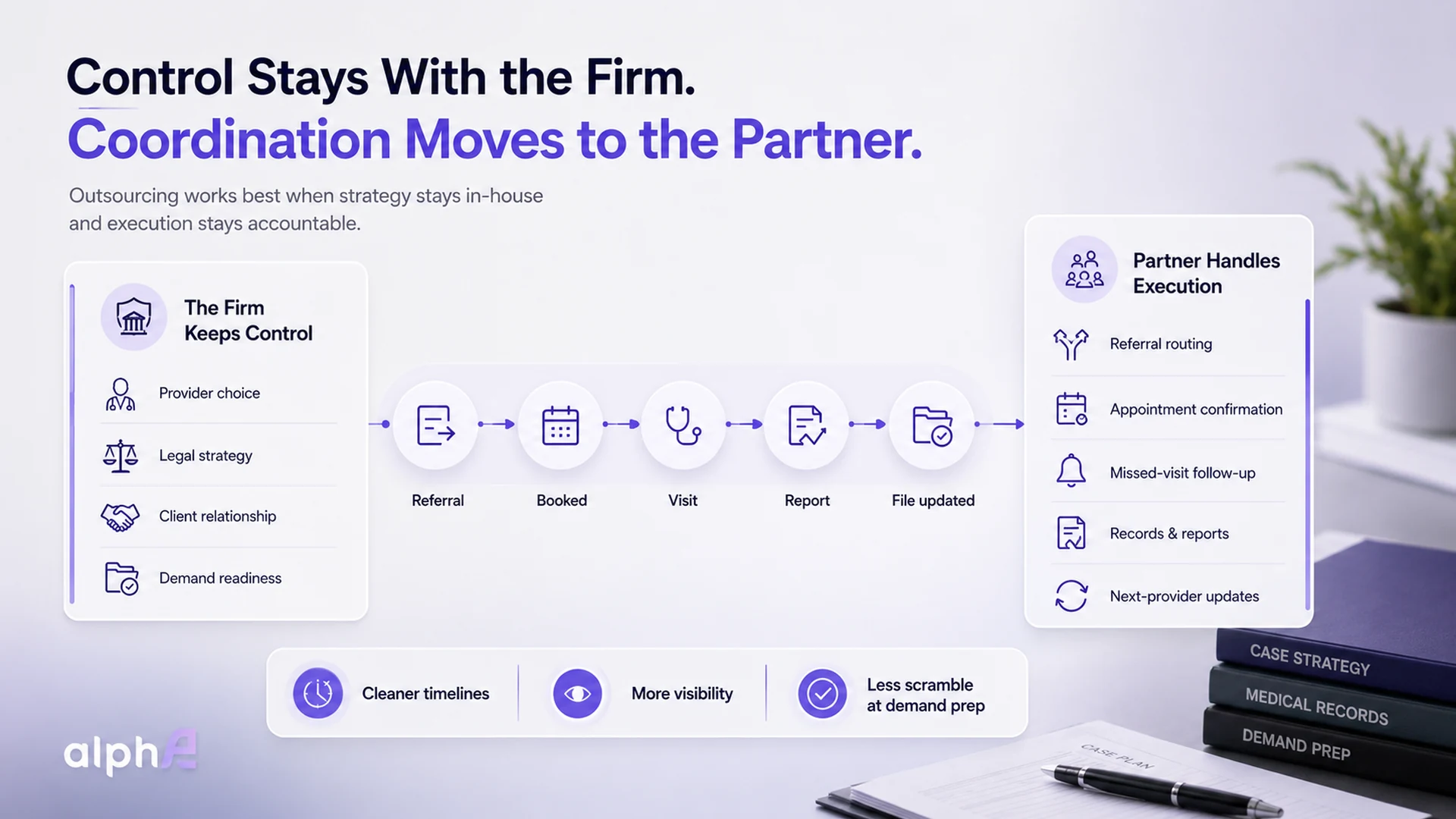
In practice, the work runs from the moment a provider is chosen through the moment records come back. It includes routing the referral to the right provider, confirming that the client has scheduled the appointment, following up when a visit is missed, tracking whether the scan or consult happened, retrieving the report, and making sure the next provider receives the relevant imaging, reports, and treatment documentation. Cases that move across several specialists, such as spine and back injuries where imaging, specialist review, and therapy each depend on the last, carry far more of these handoffs than a single-provider case ever will.
The Gap Between Sending a Referral and Owning It
There is a difference between sending a referral and owning it. Sending is a single action. Owning means staying with that referral until it closes, which can mean days of quiet follow-up spread across weeks. Firms that treat “referral sent” as the end of their responsibility often learn, later, that sent and completed were never the same thing.

When Outsourcing Medical Coordination Starts to Make Sense
There is no case count that automatically justifies outsourcing medical coordination for PI law firms. The decision is better based on operational warning signs than on a fixed caseload threshold. When several of the patterns below appear together, the in-house model is usually past its comfortable limit.
The Signals That the In-House Model Is Straining
- Records routinely arrive during demand preparation instead of before it, forcing a rush every time a case nears settlement.
- Case managers spend more of their week on medical status calls than on substantive case management work.
- Medical timelines keep showing gaps that no one caught in real time.
- Knowledge of where each case stands lives in one person’s head, so a single departure would put dozens of files at risk.
When several of these signals appear together, the cost of staying in-house may begin affecting case quality, not just staff time.
Where Outsourced Support Fits Without Losing Case Control
The most common hesitation PI firms raise about outsourced medical coordination is control. Attorneys worry that handing off the medical side means losing visibility into their own cases. With a clearly defined reporting process, outsourcing can improve visibility rather than reduce it.
Outside support does not replace the firm’s view of the case; it feeds it. A capable partner works inside a defined, repeatable process, so the firm can see referral status, appointment confirmation, and documentation progress in one place rather than reconstructing it from scattered emails. Firms that have already invested in a standardized referral handoff process tend to be the best positioned to outsource, because they know what a clean handoff looks like and can hold a partner to it.
The distinction that matters is between control and execution. The firm retains control over provider selection, legal strategy, and the client relationship. The partner manages confirmations, follow-up, and records retrieval while reporting progress back to the firm. Outsourcing execution should not mean outsourcing case control.
The Work That Stays With the Firm
Handing off this function does not make the firm a passive party. Several things stay firmly on the firm’s side, and a partner that blurs those lines is a warning sign, not a convenience.
Legal strategy stays in-house. So does the client relationship, the choice of which providers fit a given case, and the judgment about when a treatment picture is strong enough to support a demand. A good partner should make those calls easier by keeping the underlying record clean and current. It should never make them for the firm.
The same holds for the medical opinions themselves. The coordination partner may track whether a report has been received and whether it has been forwarded to the next provider. It does not interpret the medical findings. That reading belongs to the treating providers and the attorney. Keeping outsourced medical documentation support within a clearly defined role is what makes the arrangement useful and defensible.
How PI Firms Evaluate a Coordination Partner
Once a firm decides that outside coordination is the right call, the question shifts from whether to whom. A successful approach to outsourcing medical coordination for PI law firms depends on clear reporting, defined responsibilities, and consistent follow-up.
Not every provider of medical coordination services for PI attorneys works the same way, and those differences matter more than pricing does.
The clearest signal is how a partner handles accountability. A capable one does not just place calls; it owns outcomes and can show, at any point, where a given case stands. Firms that already understand why provider accountability in PI referrals matters tend to ask the sharper questions here, because they know that “we called” is not the same as “it is confirmed.”
Questions Worth Asking Before Signing On
Ask how the partner reports status, and how often. Ask what happens when a client stops responding or a provider goes quiet. Ask who owns the file when a handoff stalls, and how fast the firm hears about it. A partner that answers with process rather than reassurance is describing execution the firm can trust. One that answers in generalities is describing a black box.
The firm should also ask how the partner handles confidential medical information, limits access to case data, and documents communication with clients and providers. Other practical questions include response times, escalation procedures, experience with personal injury cases, and how performance is measured.
A reliable partner should be able to explain its process for stalled referrals, missed appointments, delayed reports, and unresolved provider communication. The scope of work should also be clear before the relationship begins, including which tasks the partner owns and which decisions remain with the firm.
How Outsourced Coordination Can Work in Practice
Consider a hypothetical firm managing ninety PI files across two case managers. In one case, an MRI order reached scheduling late, the client missed the initial call, and the report remained at the imaging center until demand preparation revealed it was missing. With outside coordination, scheduling was confirmed promptly, the client was followed up with, and the report was requested before demand preparation. The providers and client behavior did not change. The difference was that each handoff had a clear owner.
Frequently Asked Questions
What does outsourcing medical coordination for PI law firms actually cover?
It covers the chain between choosing a provider and receiving records: routing referrals, confirming appointments, following up on missed visits, tracking scans and reports, and keeping the next provider informed. It does not cover legal strategy or medical interpretation. The goal is to keep the file moving and current.
When does it make sense to outsource this work?
It usually makes sense when several strain signals show up together: records arriving during demand prep, case managers spending most of their time on status calls, and a caseload growing faster than the firm can hire. A single busy week is not a reason. A recurring pattern of files drifting is.
Can a PI firm outsource only part of the medical coordination process?
Yes. A firm may outsource specific functions such as appointment confirmation, referral tracking, report retrieval, or documentation follow-up while keeping provider selection, legal strategy, and direct client communication in-house.
How can a firm measure whether outsourced medical coordination is working?
Useful performance indicators include referral confirmation time, appointment completion rates, follow-up after missed visits, report retrieval time, unresolved handoffs, and the number of incomplete medical files discovered during demand preparation.
Final Takeaway
Outsourcing medical coordination for PI law firms becomes valuable when delayed records, missed handoffs, and repeated follow-up begin affecting case quality.
The firm should retain control over legal strategy, provider selection, and client relationships, while the coordination partner manages referral follow-up, scheduling visibility, and document retrieval. When that division is clearly defined, outside support can help produce cleaner medical timelines and more complete files.
alphaE supports Texas PI law firms with provider matching, referral tracking, scheduling visibility, and medical documentation follow-up from intake through settlement review.
If medical follow-up is taking time away from case strategy, contact alphaE to discuss a coordination workflow that fits your firm’s current process.