
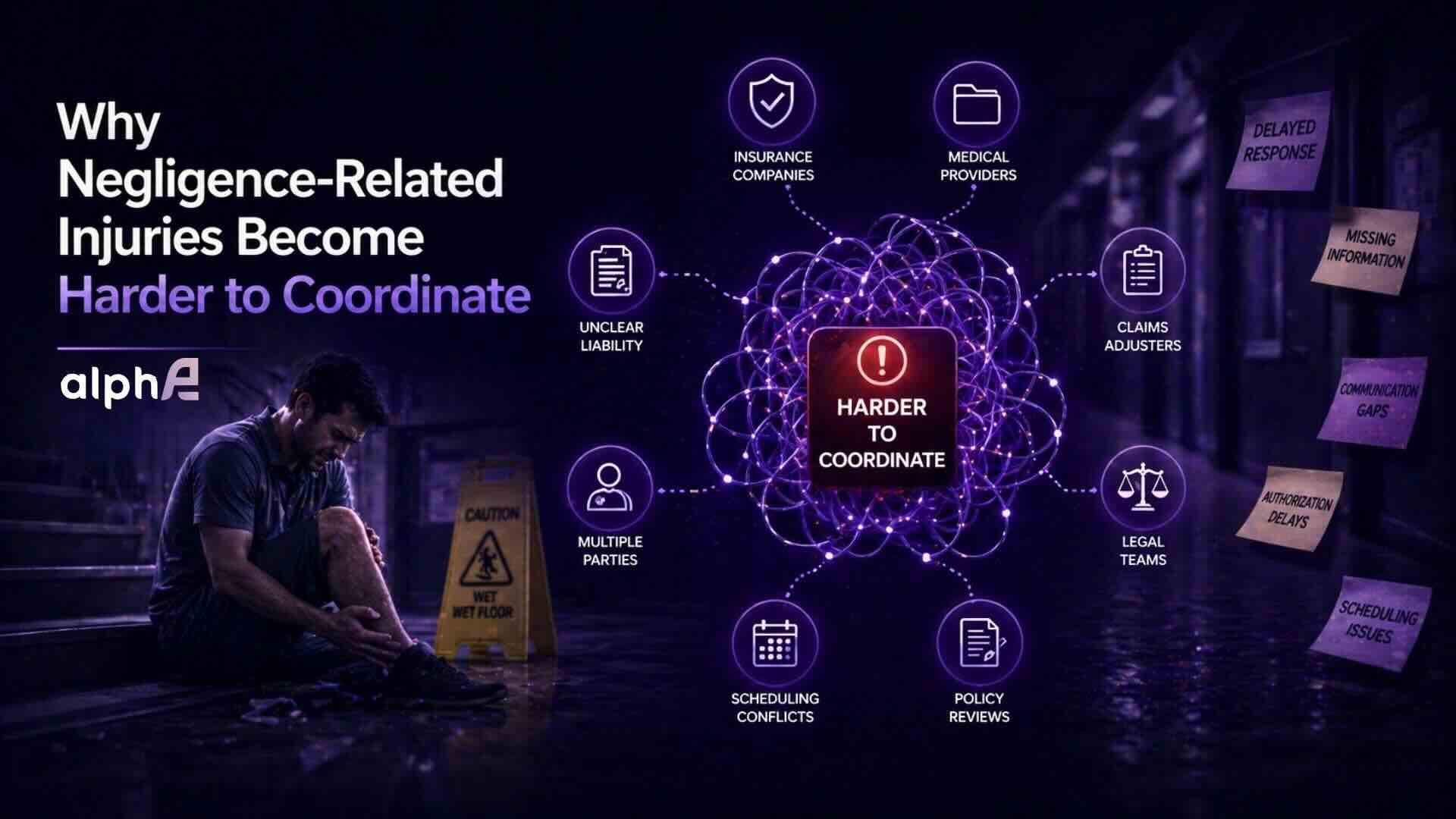
In many negligence injury claims, the case can look strong at intake but become harder to support as treatment progresses. The incident may be clear, the client may begin care on time, and the early records may not raise immediate concern.
The problem often appears later.
As the file develops, the medical record may stop reinforcing one consistent story. The timeline becomes less clear. Providers document different parts of the injury without always tying them back to the original incident. Imaging introduces findings that can be interpreted in more than one way. By the time the case reaches review, insurers may start using familiar arguments: degenerative, preexisting, unrelated, or not clearly caused by the event.
This is why medical coordination for negligence injuries matters. Strong coordination helps preserve the connection between the incident, symptoms, treatment, imaging, and follow-up care before small documentation gaps become larger causation problems.
Where Negligence Injury Coordination Breaks Down
In many cases, the breakdown starts earlier than anyone expects, often with the first medical note.
The First Breakdown in Coordinating Negligence Related Injury Cases
Consider a premises liability case. A client slips on a wet floor, feels immediate lower back pain, and seeks urgent care within 48 hours. The timeline looks clean, and treatment is timely. Nothing appears inconsistent at first glance.
But the initial record only states “back pain after fall,” a common issue in premises liability medical documentation where early records fail to anchor the mechanism of injury.
That first note becomes the place the adjuster presses on causation, forcing later records to prove what should have been preserved at the start.
This is where the record starts losing consistency in how the injury is documented.
How Weak Early Records Break Causation
In negligence-related injury coordination, once the first record fails to clearly anchor the mechanism of injury, every later note is read through that gap.
Why the First Medical Record Anchors the Entire Case
The first medical visit becomes the reference point for every provider that follows. A strong record connects the incident, symptom onset, and early findings in a way that doesn’t need to be re-established later.
In the same slip and fall case, the difference between “back pain after fall” and a detailed mechanism description determines whether later providers reinforce the injury or begin to reinterpret it.
Clinical documentation standards from the American Health Information Management Association show that specificity in early records directly shapes downstream interpretation, particularly in injury-related claims.
How Early Gaps Reshape Case Interpretation
When the mechanism is weak, the case shifts in predictable ways:
- Providers document symptoms without reconnecting them to the incident.
- Imaging begins to stand on its own instead of supporting a clear narrative.
- Insurance gains its first opportunity to question whether the condition is tied to the incident.
By the time this becomes visible, the case is being interpreted through its gaps instead of read as a clean sequence, a pattern also seen in treatment delays in workers compensation cases. This is where case value in injury claims begins to shift in negligence-related injury coordination.
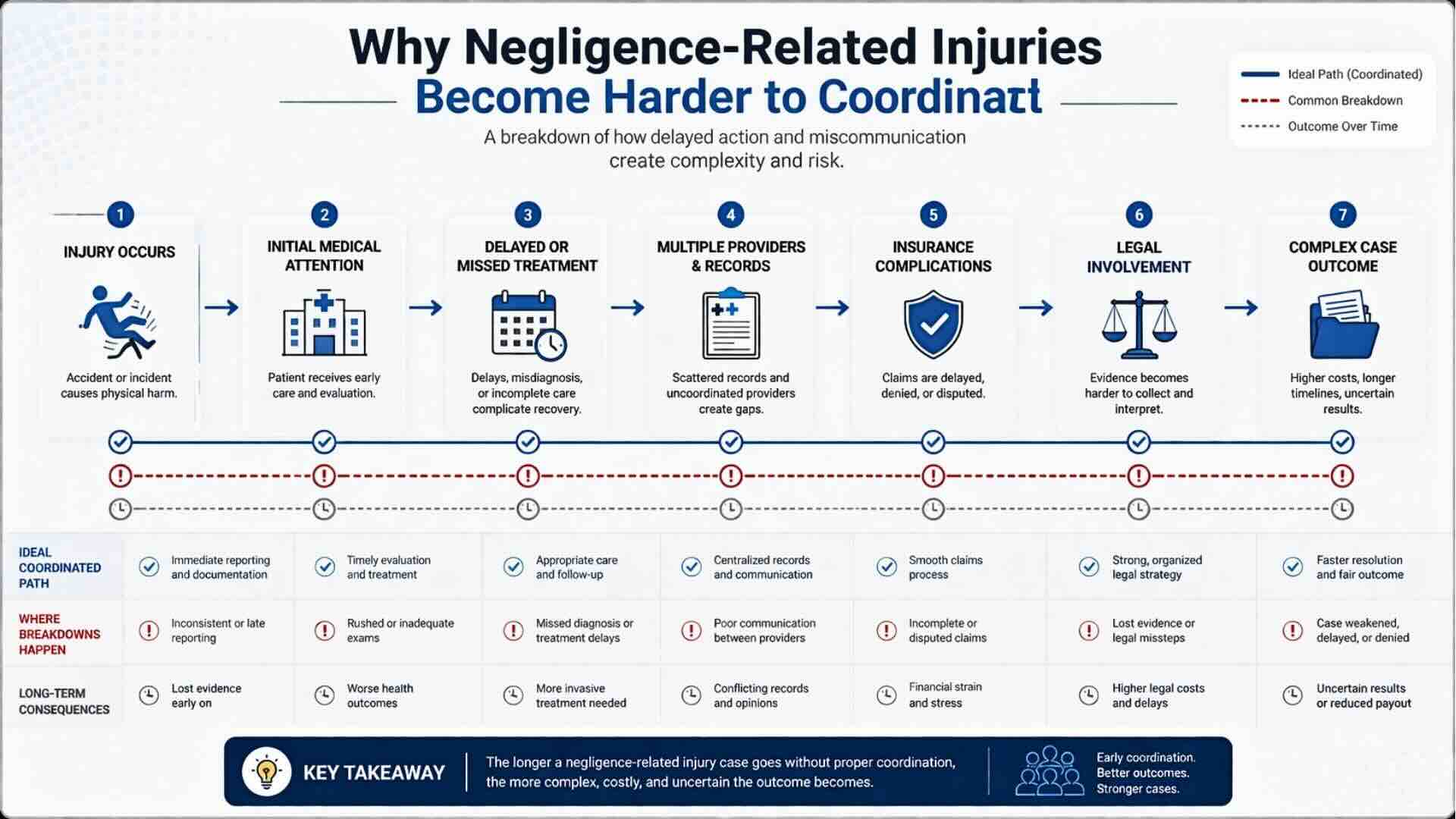
How Records Drift Across Providers
After urgent care, each provider documents a different part of the picture, including orthopedic findings, imaging, mobility, and response to treatment. If those findings are not clearly tied back to the fall, the record starts shifting away from the incident.
Without alignment in negligence-related injury coordination, those separate notes begin to look like separate conditions instead of one continuous injury path.
This is often the first point where the defense starts to gain leverage. Not because the injury is unclear, but because the records no longer point in the same direction.
How MRI Findings Can Create Causation Problems
Imaging can help clarify an injury, but it can also create new complications when the earlier record is thin.
For example, two weeks after a fall, the client receives an MRI. The report shows a disc bulge and mild degenerative changes. The injury may still be legitimate, but the language in the report gives the insurer another way to interpret the file.
Degenerative spine findings are common, even among people without symptoms. A widely cited study in the American Journal of Neuroradiology found that many asymptomatic individuals show disc abnormalities on MRI. That means imaging alone does not always establish causation in a negligence injury claim.
If the early records clearly connect the incident to symptom onset and progression, the MRI can support the treatment path. If they do not, the same MRI may create a competing narrative:
“There is no clear documentation tying these findings to the fall.”
At that point, the case becomes less about whether the client has an injury and more about whether the record clearly connects that injury to the incident.
How Insurance Uses Documentation Gaps
Insurance carriers usually do not need to prove that an injury does not exist. They often only need to make the connection between the injury and the incident feel less certain.
A vague mechanism note, a delay before imaging, or a specialist record that stops referencing the incident can all create leverage. The argument shifts from injury severity to proof.
Instead of discussing the full value of the claim, the attorney may have to explain why the gaps should not define the case. That shift can weaken settlement positioning because the record is no longer carrying the narrative on its own.
This is where negligence injury coordination becomes important. The stronger and more consistent the record is across providers, the less room there is for the claim to be reframed around uncertainty.
Common Treatment Challenges in Negligence Injury Claims
Many treatment challenges in negligence injury claims come from ordinary decisions that do not seem problematic in real time. The issue is that small coordination gaps can later reshape how the case is interpreted.
Common problems include:
- Treating early records as complete when the mechanism is still vague.
- Sending referrals without enough context about the incident and symptom progression.
- Allowing providers to document in isolation.
- Failing to connect imaging findings back to early complaints.
- Letting follow-up care slow down without clear documentation.
- Choosing providers who can treat the injury but do not document well for PI case needs.
These issues do not always create immediate concern. But over time, they can make the medical timeline harder to follow and easier to challenge.
Medical Coordination for Negligence Injuries
Strong medical-legal coordination is not about controlling treatment. It is about keeping the case aligned as treatment progresses.
In a negligence injury claim, the difference between a stable case and a drifting one is whether each stage of care continues reinforcing causation.
Where Coordination Protects Case Value
Most breakdowns occur at the same moments:
- at intake, where the mechanism is not clearly anchored.
- at referral, where documentation shifts from incident to condition.
- right before imaging, where timing shapes how findings are interpreted.
When negligence-related injury coordination holds at these points, the record stays aligned. Causation remains clear, and imaging supports the injury instead of creating competing interpretations.
When it doesn’t, insurance gains room to challenge the connection, and once that happens, settlement value rarely recovers to its original range.
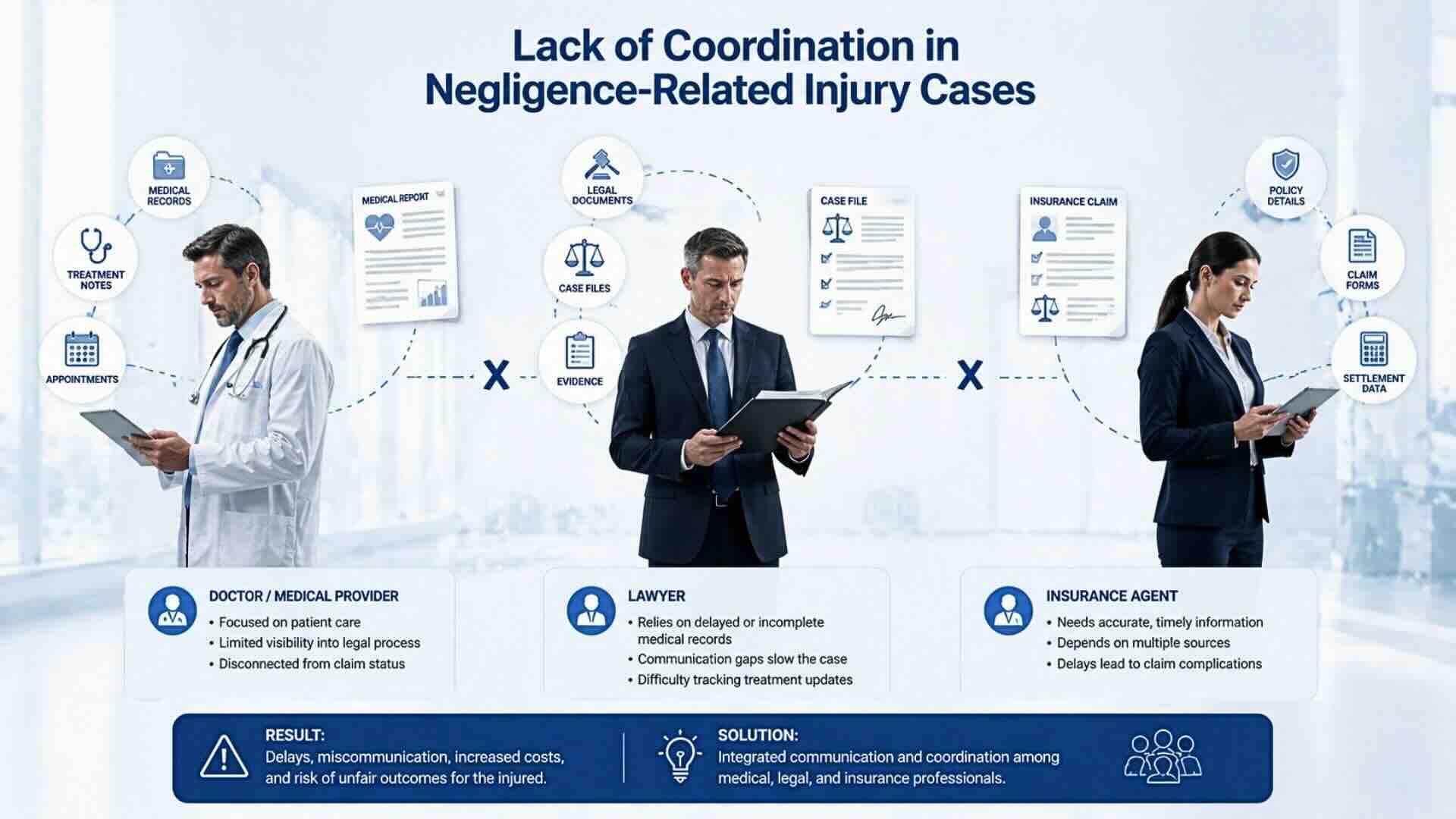
Why Negligence Injury Coordination Determines Case Clarity
A real injury can still become a weak file if the record does not preserve the relationship between the incident and the treatment.
In the slip-and-fall example, the injury itself may not change. What changes is how easily the record can be interpreted in more than one way.
That is the real risk in negligence injury claims. The case may not fail because the client was not hurt. It may weaken because the medical record does not consistently support the connection between the event, symptoms, imaging, and treatment progression.
Medical coordination helps protect against that risk by keeping the case organized before gaps become arguments.
Conclusion
Negligence-related injury coordination becomes harder when the medical record stops clearly supporting causation. The injury itself may remain valid, but if providers, imaging, referrals, and follow-up care do not stay aligned, insurers gain more room to challenge the connection.
Strong medical coordination helps preserve the timeline, reduce documentation gaps, and keep the case narrative consistent from intake through treatment.
alphaE helps Texas PI attorneys coordinate LOP-based medical care, referrals, follow-up, and documentation so negligence injury claims remain clearer, stronger, and easier to support.